dewfall

caught in the web

20 HP

A sequencer you fill by playing. What you play sticks to an orb web as dewdrops, where it landed in the bar. A spider walks the web on your clock and plays it back, while old catches are wrapped in silk, quieter and duller, and then eaten.

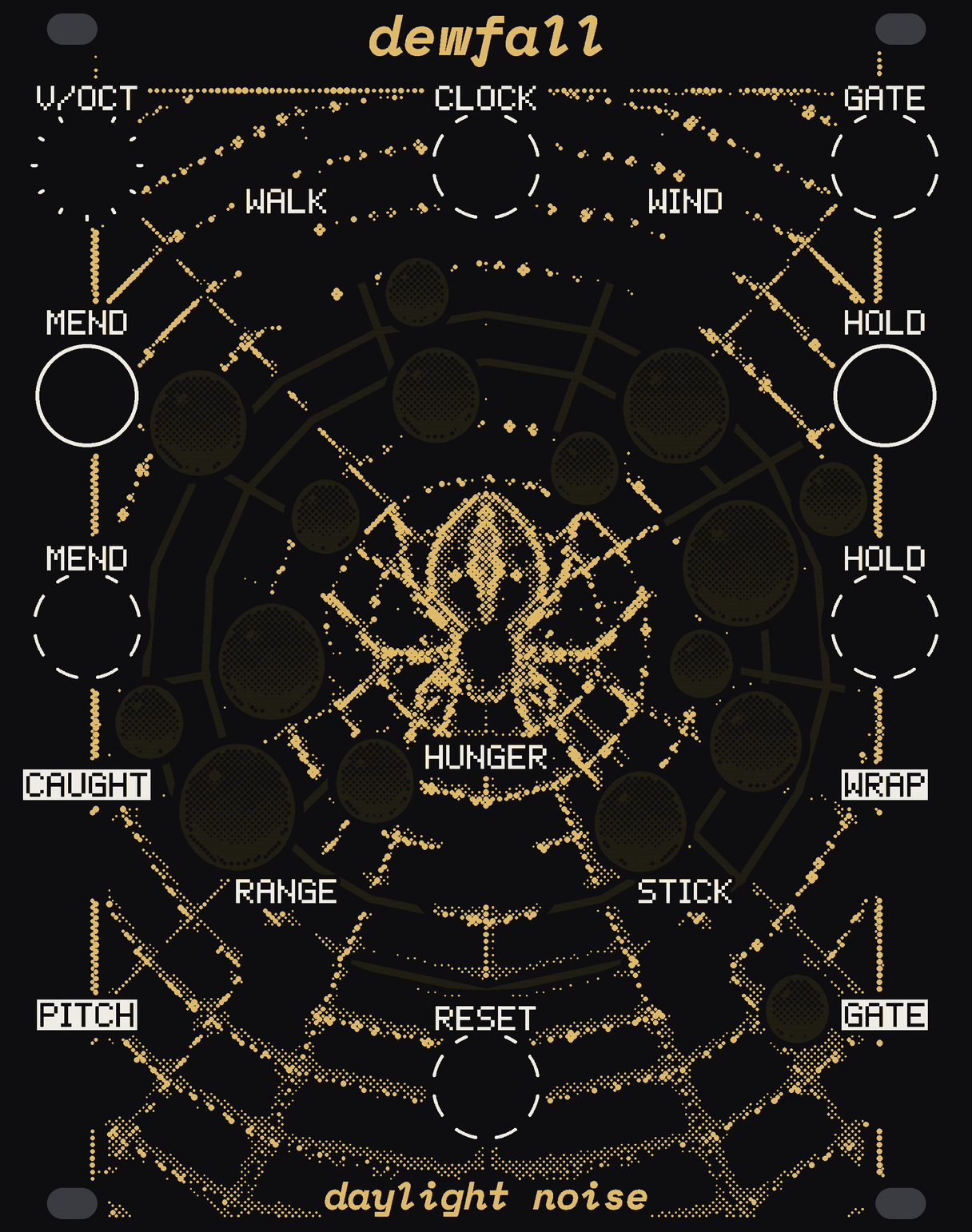
The DEWFALL panel, black and gold: a photograph in gold halftone looking out through a dark timber doorway at dawn, its posts lit only along their inner edges, with an orb web strung across it. The fine silk glints where the low light catches it, beaded with tiny dew, and a garden spider hangs head down at the hub, its banded legs on the spokes. Sixteen clear dewdrops of different sizes hang along the spiral threads, each a window of bare glass with a bright crescent low in it, and the inner web's eight spokes and two rings of silk are bare glass too. HUNGER, the big knob, sits under the spider; WALK and WIND high in the web, RANGE and STICK low; MEND and HOLD lit buttons over their gate jacks; V/OCT, CLOCK and GATE in along the top, CAUGHT, WRAP, PITCH and GATE out down the sides, RESET at the foot.

Turn a knob: drag it or tap either side of it, roll the wheel over it or use the arrow keys; a double click puts it back. Press HOLD to keep the web as it is (press again to let go), MEND to clear it. The patches step on by themselves until you touch anything.

Synthesised here. DEWFALL makes no sound: you're hearing a stand-in rack, its kalimba playing into V/OCT and GATE, its clock in CLOCK, and the module's outs playing its glassy pluck.

example patches

Everything DEWFALL does here is its engine as designed, in your browser: the catching, the walk, the wrapping and the eating. The kalimba, the pluck, the bass and the kit are a stand-in rack.

Caught in the web

Patch a line into V/OCT and GATE: a keyboard, another sequencer, a voice's own notes. Whatever you play sticks to the web as a dewdrop, on the spoke for that part of the bar. The spider waits at the hub, walks the web a spoke a clock, and plays what's caught out of PITCH and GATE. A bar later you hear your own line come back.

Keep playing and the web follows you. New notes take their places. Old ones go round a few more times, paler and quieter, and then the spider eats them. So the sequence is always the last things you played, fading. You play into it like an echo, and it answers like a sequencer.

The web

The spider

Wrapped and eaten

In a rack

Specs

Format

Width
20 HP
Controls
a big knob (HUNGER), four knobs (WALK, WIND, RANGE, STICK), two lit buttons (MEND, HOLD)
Lights
17 windows on 77 RGB LEDs: the sixteen dewdrops and the inner web's silk
Replaces
a sequencer you record by playing, a layer of chance, a memory that forgets and a humaniser
Parts
a demo for now: the line's knobs, jacks and buttons, no board yet

Inputs

V/OCT
1 V/oct, read as GATE rises
GATE
gate: a note into the web on each rising edge
CLOCK
gate: a step on each rising edge; empty, a step every 0.25 s
RESET
gate: back to the first spoke
MEND
gate: clears the web
HOLD
gate: holds the web while high

Outputs

PITCH
1 V/oct, the note the spider plays
GATE
5 V, half a step on each note
CAUGHT
trigger: a note stuck
WRAP
0 to 8 V, how wrapped each note is