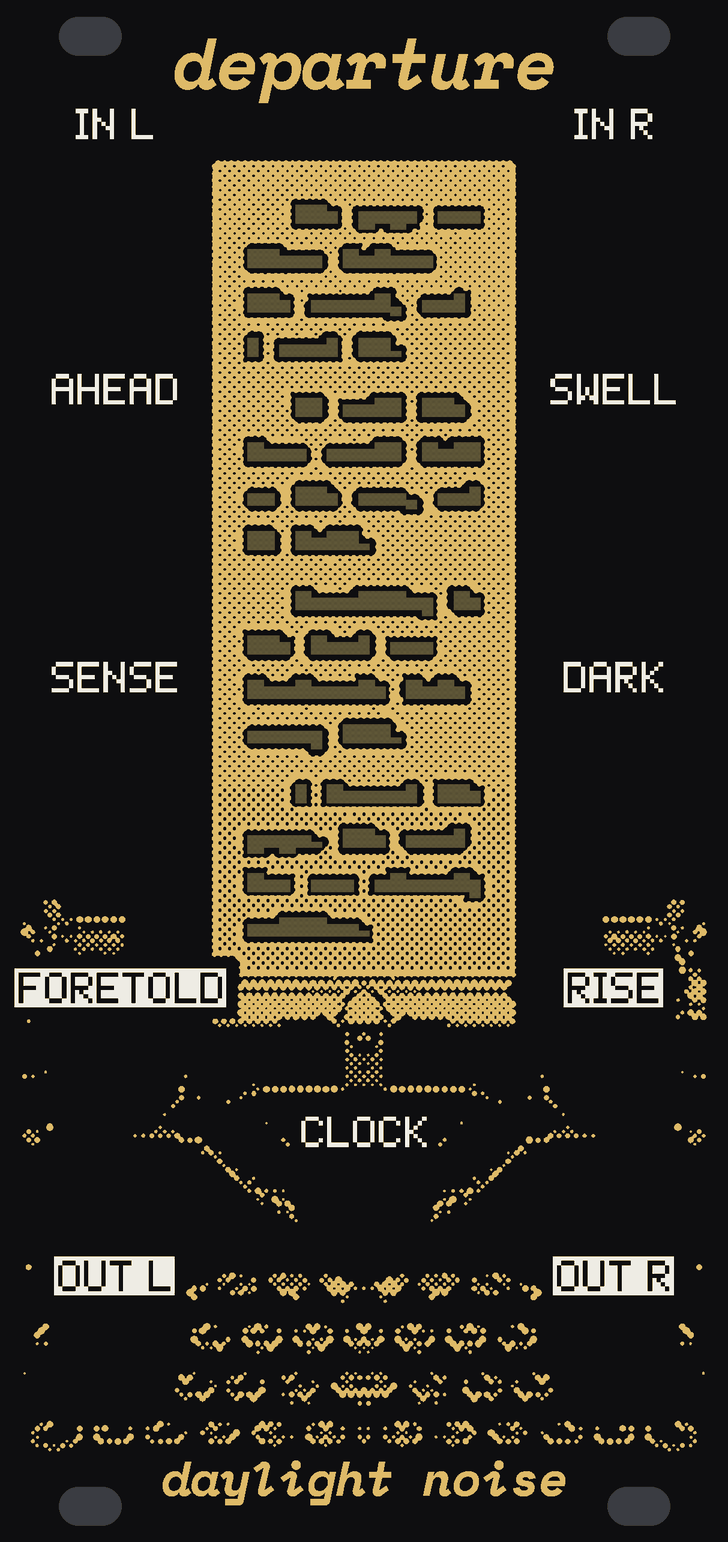
12 HP · effect
An effect that hears one bar into the future. Everything through it comes out exactly a bar late, on the clock, so a loop lands where it always did; but it has heard every hit coming, and warns of each one before it arrives.
Turn a knob: drag it, roll the wheel over it or use the arrow keys; a double click puts it back. AHEAD steps between its eight lengths.
example patches
The page's lines and the warnings here are DEPARTURE's own engine, the module's, running in your browser sample for sample: the bar it waits, every hit it hears, every warning, every light. The rest is a stand-in for a rack.
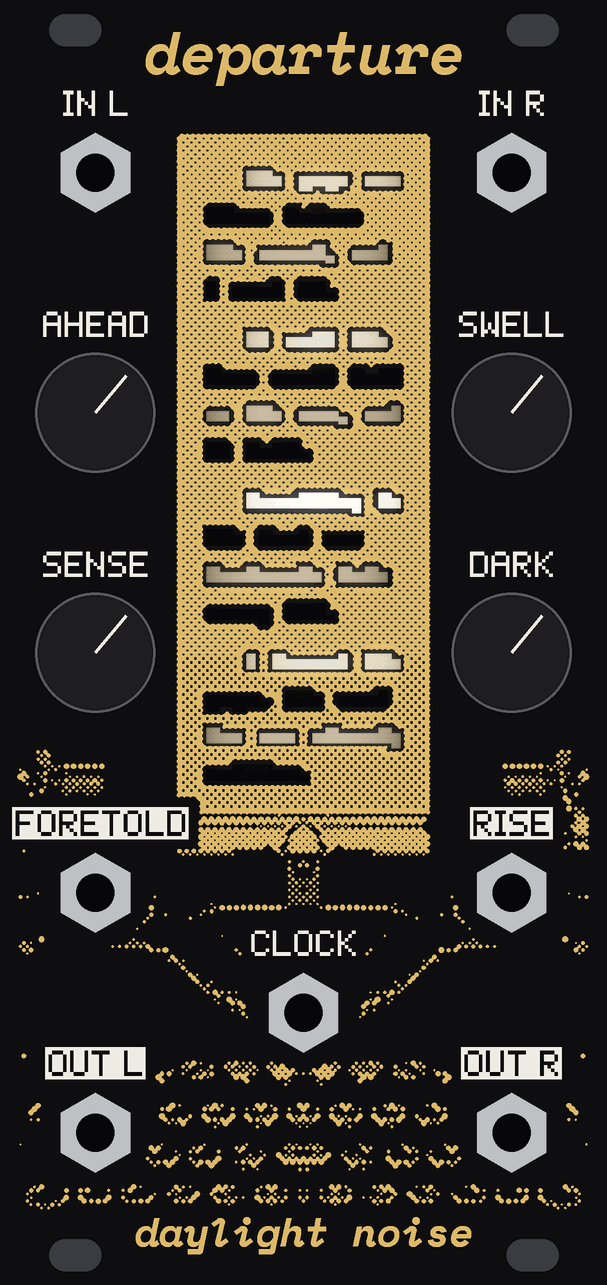
CLOCK takes quarter notes, and four of them are the bar it waits. Whatever goes in comes out exactly that long after, at full level and untouched, so a groove that repeats every bar lands where it always did. Change the tempo and it follows within a bar, without a click.
The page in the middle is the bar it has already heard: sixteen typed lines, a line a sixteenth, a paragraph a beat. Each hit is written on its line the moment it comes in, swells brighter as its warning plays, and flashes white as it lands.
Every hit it counts gets a warning that starts ahead of it and stops dead as the hit lands, so the hit itself comes through clean. The swell is a reversed reverb of the hit rising into it, the sound of a snare's reverb played backwards, made for every hit on its own.
DARK takes the warning over: the hit itself, pitched down, in pieces playing forwards and backwards, creeping in early and growing into the hit. Turned all the way, it's a voice under the floor.
The rest of the rack can hear the future too. FORETOLD fires as each warning starts: play a note an eighth before every snare. RISE climbs into every hit and falls the moment it lands: open a filter before the kick, or turn it over and duck a pad, already down when the kick lands.
Twelve HP, every part on the line's staggered grid and mirrored about the middle. The page fills the middle: sixteen typed lines of circuit board lit from behind, every word its own window. The art is a typewriter in gold dots, the paper a sheet of gold.
One four-layer board sits 10 mm behind the panel, with the jacks, the knobs and 32 RGB LEDs on its front and everything else on its back. Two lights sit under each line, in a channel of a printed black block that walls every line off from the next, so a written line glows beside a dark one. An RP2350 runs the engine on both its cores, 46,875 times a second, and keeps the bar it waits in 8 MB of PSRAM. RISE comes from a 16-bit DAC, calibrated over USB with a meter.