try it again, slower
28 HP
A sampler with its sound on a plastic card. Pull a card through a real magnetic head by hand and it plays at the speed of your hand: slow is low and dark, stop and it stops, back is backwards. Pull it in time and the rack keeps it. Otherwise, a flat buzz, and it's gone.
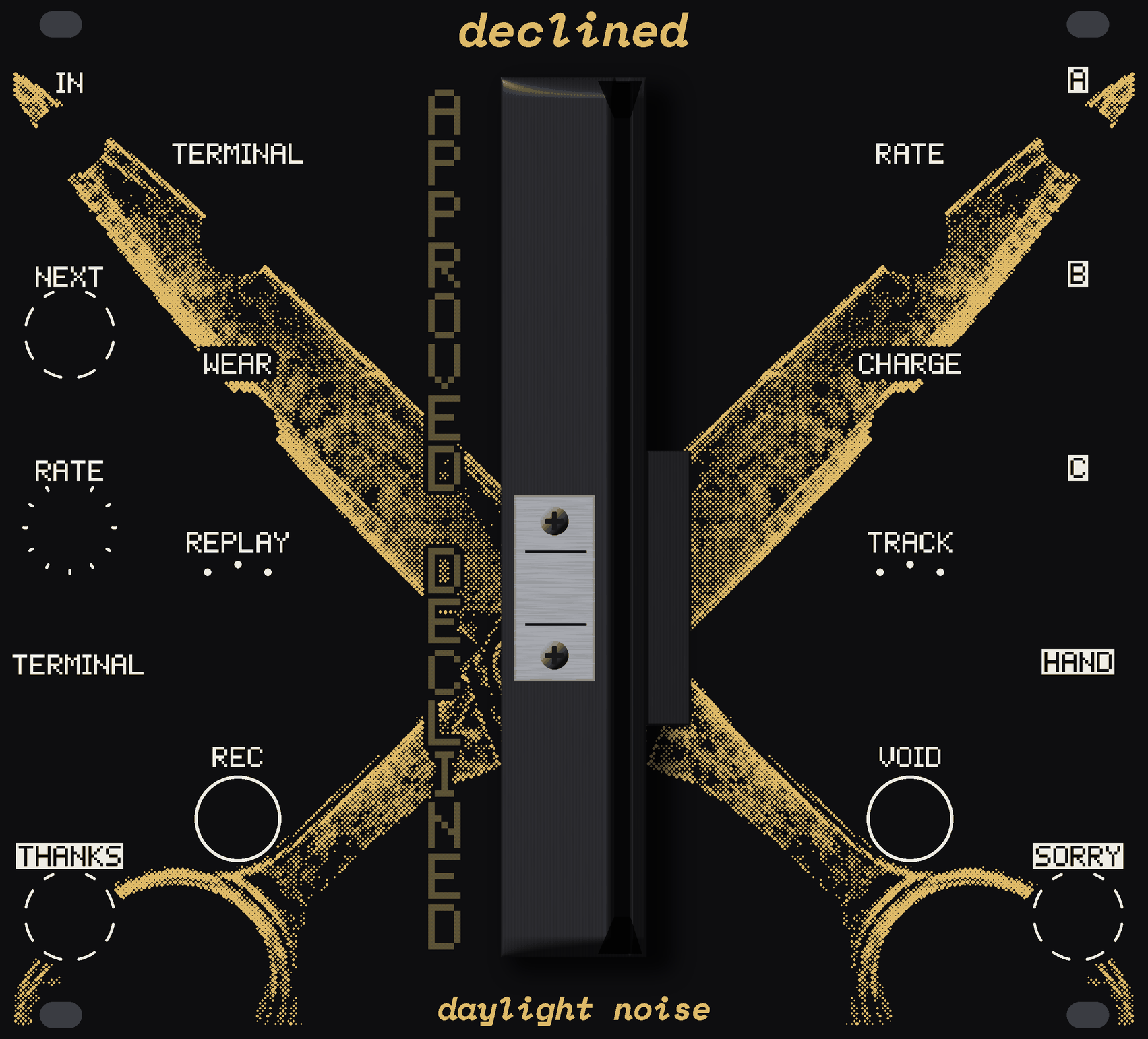
Pull the card: drag it down the rail and out of the foot, or back up; with the keys, hold the down or up arrow on it, and left and right pick how fast. Start it higher for the whole stripe. Turn a knob: drag it or tap either side of it, roll the wheel over it or use the arrow keys; a double click puts a knob back. REPLAY and TRACK click from stop to stop the same way. Hold REC while you pull to write. The patches step on by themselves until you touch something.
example patches
A browser has no magnetic head, so the page stands in for it: the card is a drawing, your pointer is the hand, and the stripe and the head's losses are worked out here. The real one reads a real stripe. The five cards are invented, every number on them. What DECLINED does with what it reads is its engine as designed, running in your browser. The hand in the patches, the drums, the bass and the riff are a stand-in for the rest of a rack.
A card stands in a leaning rail with its stripe against a magnetic head, and there's no motor. You're the capstan. What's on the stripe comes out at the speed of your hand, on three tracks at once, so one pull is three layers. A real stripe holds real data, and data through an audio head is a steady tone for the zeros at each end and a screech of chirps between them, different on every card. Pull slowly and it's a growl with a beat in it.
The wallet you already own is a sample library: a hotel key, a gym pass, a library card. It reads a stripe as sound and nothing else. It never decodes one, and anything it keeps is gone when the power goes off.
Every pull that leaves the head by the end of the card, at least 60 mm from where it started or last turned, is judged. In the window it's approved, and kept. Outside it, a flat two-tone buzz, and it's thrown away, and what you had stays. Pull it out the way it came and there's no verdict at all.
Hold REC and pull, and what's at IN goes onto the stripe at your hand's speed, a second or two of it. A second write head sits 9 mm above the read head, so on a pull down you hear what you've just written a moment later, off the card. Read it back on another pull and it wobbles twice. A write gets no verdict. It writes over what's there, so use a blank.