darkroom

it comes up in the tray

20 HP

A looper whose loops develop. Hold EXPOSE while you play and the bars become a print in a developing tray: it comes back as a dark smear and comes up, over seconds or minutes, into what you played. STOP hangs it up; leave it in and it goes over.

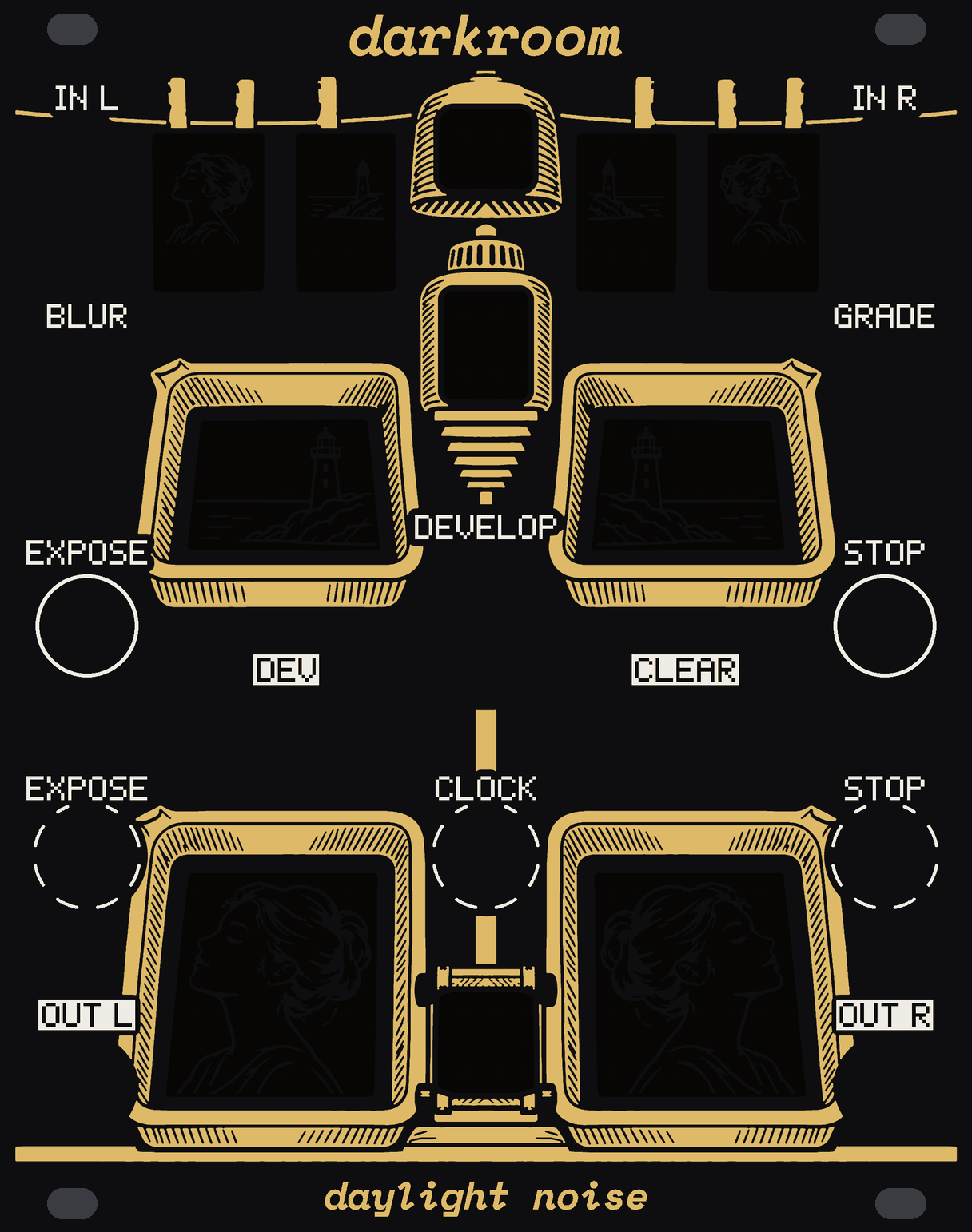
The DARKROOM panel, black and gold: a darkroom bench drawn in gold ink with hatching. Four shallow developing trays with thick moulded rims, a big one at the front and a small one at the back on each side, each holding a print of bare glass with a picture drawn over it in black lines, a woman's profile in the big trays and a lighthouse on a rocky point in the small ones. Across the top a line strung from side to side with four prints pegged on it, the same pictures smaller. A safelight hangs at the top in the middle; under it an enlarger stands up the middle, its lamp house, its pleated bellows and its lens, its column down past the big DEVELOP knob to a baseboard and an easel at the foot. The other knobs and the jacks run down the outer sides, two outs on the bench between the trays.

Turn a knob: drag it or tap either side of it, roll the wheel over it or use the arrow keys; a double click puts it back. Hold EXPOSE for as many bars as you want the print (a tap is one bar); press STOP to hang the oldest print up. The patches step on by themselves until you touch anything.

Synthesised here, as the module would make it: the four prints coming up out of the dark, round a stand-in band.

example patches

DARKROOM here is its engine as designed, in your browser: it hears only what comes into its jacks. The band, the beeps, the clock and the hand on EXPOSE and STOP are a stand-in rack.

One cable, a print

Put what you play into IN L and IN R (one cable does both), a clock into CLOCK, and OUT L and OUT R to your mixer. What comes in goes straight through. Hold EXPOSE while you play: from the bar line, the enlarger records for as long as you hold it, in whole bars (a tap is one bar, four at most). On the bar line after, those bars become a print in the next tray.

The print doesn't come back as you played it. It comes back as a dark smear, the notes run together in a wash, and it comes up by itself: the notes find their places, the top end comes back, it gets louder, and after a while it's your loop, clear and in time. You don't have to catch the bar line: pressed in the first beat of a bar, EXPOSE starts from that bar's line, so nothing you played is lost.

Coming up

STOP, or leave it in

Four trays, and the line

BLUR and GRADE

DEV and CLEAR

Specs

Format

Width
20 HP
Controls
a big knob (DEVELOP), two knobs (BLUR, GRADE), two lit buttons (EXPOSE, STOP)
Lights
four trays' prints, four prints on the line, the safelight, the enlarger's lamp house and its easel: 56 RGB lights
Memory
four prints of one to four bars, up to 6 s each, stereo
Replaces
a four-track looper, a slow swell and focus pull for every layer (a filter, a VCA, a reverb and a long envelope each), and a dynamics shaper with a drive
Here
a demo: the parts and the engine as designed, no board yet

Inputs

IN L
audio: the left side (both with nothing in IN R); passes straight through
IN R
audio: the right side
CLOCK
gate: sixteenths, 16 to a bar (unpatched: its own 120 BPM)
EXPOSE
gate: a rise is a press of EXPOSE, held while it's high
STOP
gate: a rise is a press of STOP

Outputs

OUT L
audio: what comes in and the prints
OUT R
audio
DEV
CV, 0 to 8 V: the newest print's development (5 V clear)
CLEAR
trigger, 5 V for 10 ms: a print came up clear