crush depth

how deep can it go

20 HP

A stereo compressor that is a boat's hull, diving. The deeper it goes, the harder the sea squeezes the sound: untouched at the surface, glued and heavy at working depth, and past the hull's line the hull gives. Rivets shoot out on the hits, the steel groans, water sprays in.

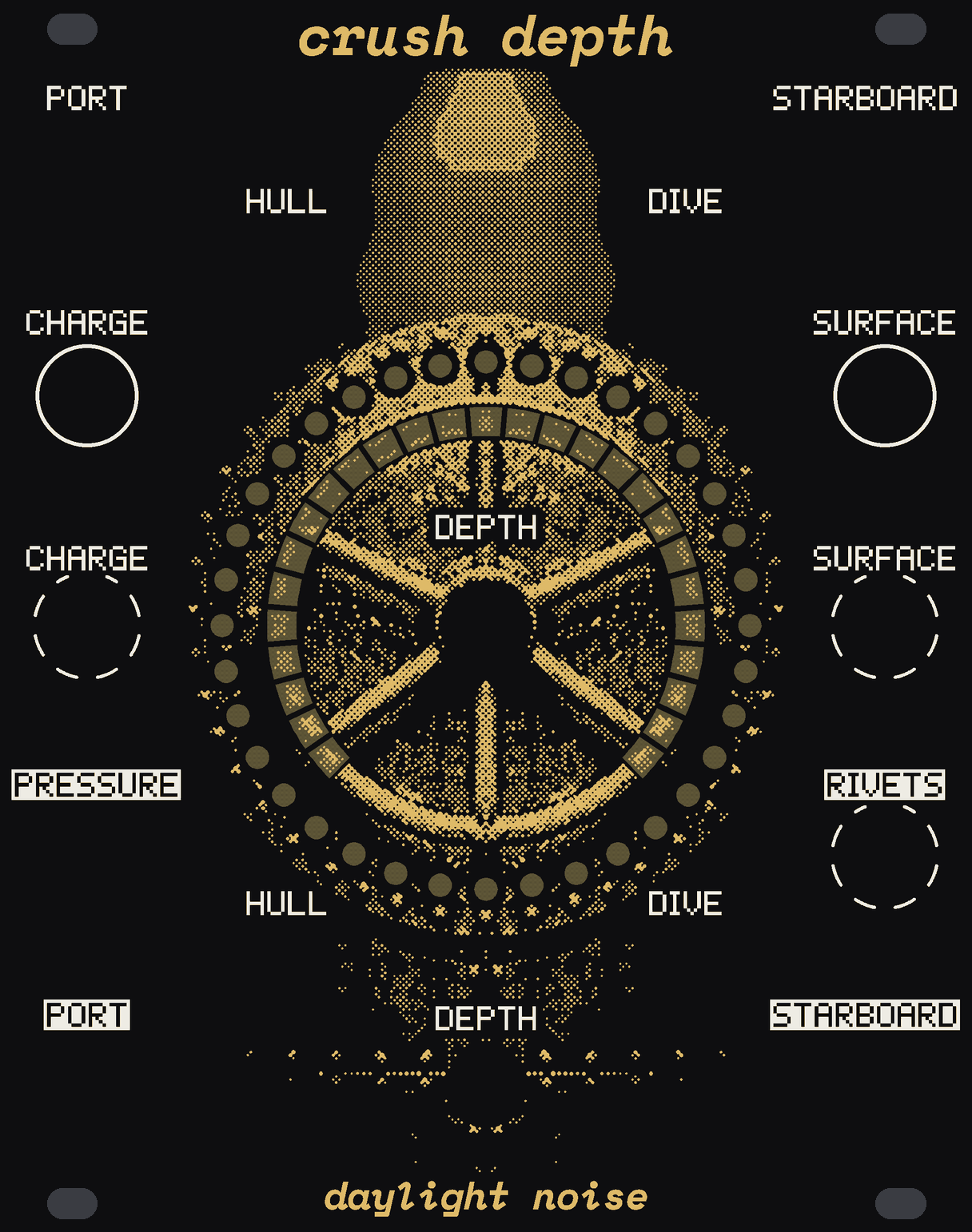
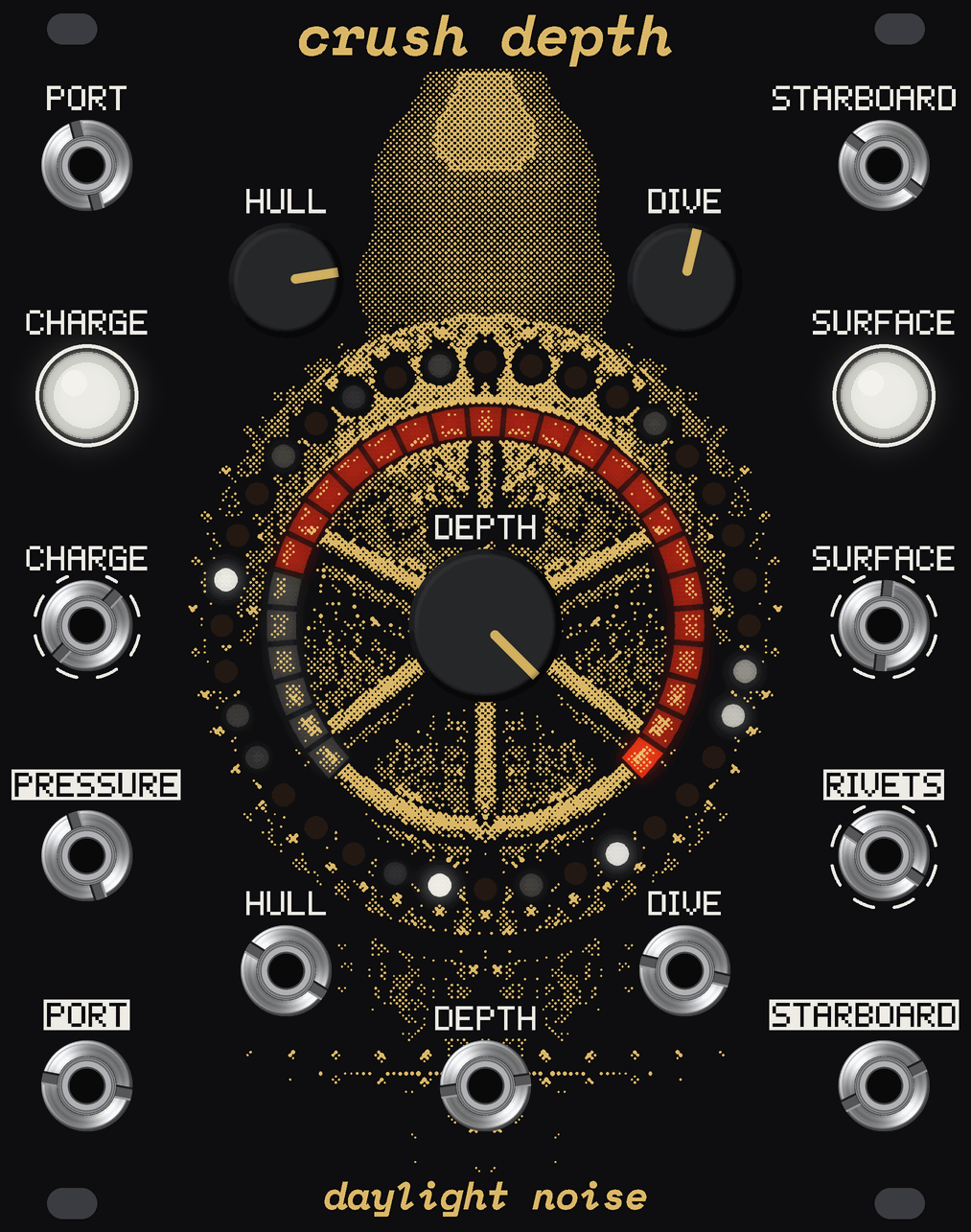
The CRUSH DEPTH panel: black, gold dots of a round watertight hatch in a riveted steel wall, its spoked wheel in the middle. Round the big DEPTH knob on the wheel's hub, the wheel's rim is a gauge of 27 windows of bare circuit board, and a ring of 36 small round windows runs round it where the hatch's rivets are. PORT and STARBOARD in at the top corners, HULL and DIVE either side above the hatch, CHARGE's and SURFACE's buttons over their jacks down the sides, PRESSURE and RIVETS out under them, the HULL and DIVE jacks under the hatch, DEPTH's jack and the PORT and STARBOARD outs at the foot. crush depth at the top, daylight noise at the bottom.

Turn a knob: drag it or tap either side of it, roll the wheel over it or use the arrow keys; a double click puts it back. CHARGE and SURFACE are buttons: press CHARGE; hold SURFACE down. The patches step on by themselves until you touch anything.

A dark loop in F minor, the whole mix through CRUSH DEPTH. Listen plays the patch from its top.

example patches

The squeeze, the hull, every rivet, the gauge and every out here are CRUSH DEPTH's engine, the module's own code, running in your browser. The loop is a stand-in rack.
The dive

Both sides are squeezed together, so the stereo picture holds. The gauge round DEPTH is the squeeze as it happens: the needle a lit segment, 30 dB across, the travel behind it glowing faintly.

The hull

Every hull has a line: the squeeze it was built to take, a lit segment on the gauge. Short of it the hull is silent. Past it the gauge lights red, the needle trembles, and the further past, the worse it gets: the steel creaks and groans, pitched by the hull and bent by the squeeze; the hits that push against the squeeze shoot rivets out, and past a few decibels they go by themselves; water sprays in where each went; now and then the hull buckles.

Charges and the surface

What comes out

Inside

One board sits 10 mm behind the panel with everything on its front: the jacks, the knobs, both buttons, the 90 LEDs and the whole circuit, the USB-C in a notch in its top edge. Each gauge segment has a white LED and a red one in its own cell of a black printed baffle, so the needle reads segment by segment and the gauge turns red past the hull's line; each rivet has a white one. An RP2350 squeezes the sound on one core and lets the rivets go on the other.

The CRUSH DEPTH panel at crush depth: the gauge round the big DEPTH knob lit red past the hull's line, rivets lit round it, its knobs and buttons on.

Drag it or use the arrow keys to turn it; click it to take it apart.

Specs

Format

Width
20 HP
Depth
20.8 mm behind the panel
+12 V
about 67 mA dark, 90 mA in usual play, 200 mA at crush depth, 215 mA at the most (estimated)
−12 V
about 4 mA (estimated)
+5 V
not used
Controls
a big knob, 2 knobs, 2 lit buttons

I/O

PORT, STARBOARD in
audio, 24-bit; ±10 V reaches the converter unclipped; STARBOARD takes PORT when it's empty
CVs
DEPTH, HULL, DIVE: added to the knobs, 5 V the whole way; −5 to +5 V, safe to ±12 V
CHARGE, SURFACE
trigger and gate, high past about 0.9 V; safe to ±12 V
PORT, STARBOARD out
audio, 24-bit, exact to ±7.5 V, a soft knee that never passes 8.75 V; about 3.5 ms in to out
PRESSURE
CV, 0 to 8 V across the gauge's 30 dB, 16-bit
RIVETS
trigger, 0/5 V, 10 ms

Engine

Brain
RP2350, both cores, at 46.875 kHz, 32-bit float
Light
63 windows, 90 LEDs: a white under each, a red beside each gauge segment's; 200 frames a second
Power cycle
it wakes at the bottom, its hull new; only the calibration is kept