crosstalk

it plays your case

20 HP

A radio for the electricity in your case. It listens to its own power rails, the lights blinking, the clocks, the digital whines, the supply singing far above hearing, and tunes any of it down to where you can hear it. It only listens: nothing goes back onto the bus.

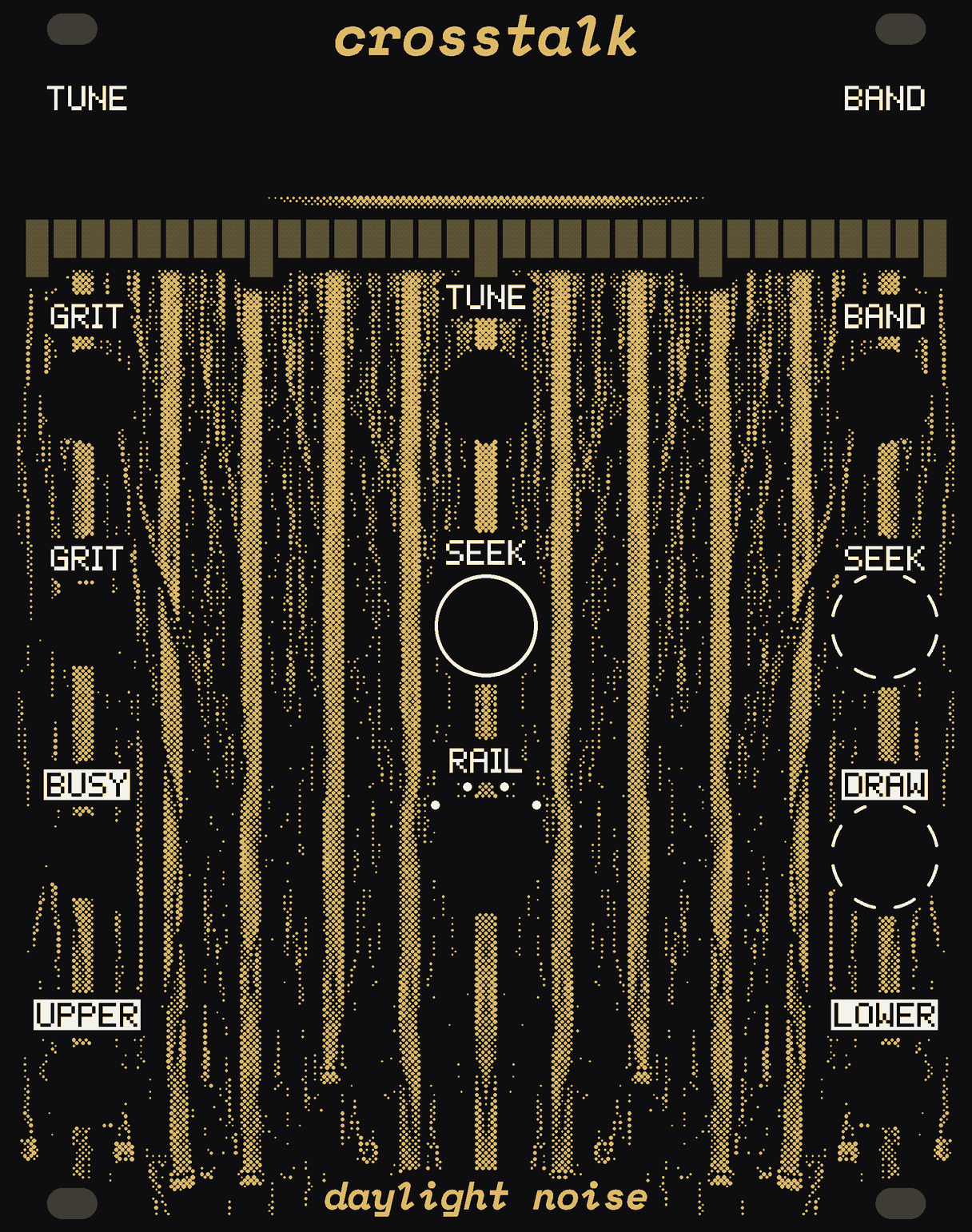
The CROSSTALK panel: black, gold dots of a curtain of wires and ribbon cables hanging from a long dial into the dark, edge to edge, their plugs dangling at the foot; the dial runs the panel's width, a window of bare circuit board in 33 cells, every eighth one long. TUNE and BAND's jacks at the top corners over the dial, GRIT and BAND down the sides level with the big TUNE knob under the dial, GRIT's and SEEK's jacks level with SEEK's button, BUSY and DRAW out under them, RAIL's switch on the spine, UPPER and LOWER out at the foot corners. crosstalk at the top, daylight noise at the bottom.

Turn a knob: drag it or tap either side of it, roll the wheel over it or use the arrow keys; a double click puts it back. RAIL clicks round its four stops the same way. SEEK is a button: press it. The patches step on by themselves until you touch anything.

A stand-in case playing a dark loop in A minor, CROSSTALK's UPPER on the left and LOWER on the right over it. Listen plays the patch from its top.

example patches

Everything CROSSTALK does here is its engine as designed, running in your browser. A page can't hear your case, so it plays a stand-in case of its own: on a rack, CROSSTALK hears that rack.

Tuning in

Every module puts its life on the power bus. CROSSTALK mixes the rail with a tone of its own and plays the difference, as a shortwave radio brings a station down to where you can hear it.

What it hears

It hears your case as it is: patch something new and it sounds different. A linear supply hums along the low end; a switching one sings far up. It hears a little of itself too, faintly.

The dial

Thirty-three cells across the panel, from 20 Hz at the left to 200 kHz at the right, the decades long. Each glows with how busy its part of the band is; the cells BAND hears are brighter; the brightest is the needle, where TUNE is.

What comes out

Specs

Format

Width
20 HP
Controls
a big knob, two knobs, a four-way switch, a button

Inputs

TUNE, BAND
CV, added to the knobs, 5 V the whole way
GRIT
CV, added to the knob, 5 V the whole way
SEEK
gate, rising past 1 V

Outputs

UPPER, LOWER
audio, ±5 V
BUSY
CV, 0 to 8 V
DRAW
gate, 0/5 V, 10 ms