cradle

clack, clack, and a wash

20 HP

A delay that swings like five steel balls on strings. A hit goes in at the left ball and comes back on the right, then the left, softer every swing, a flam of taps running through the middle each time, until the order goes and the echoes melt into a swaying wash.

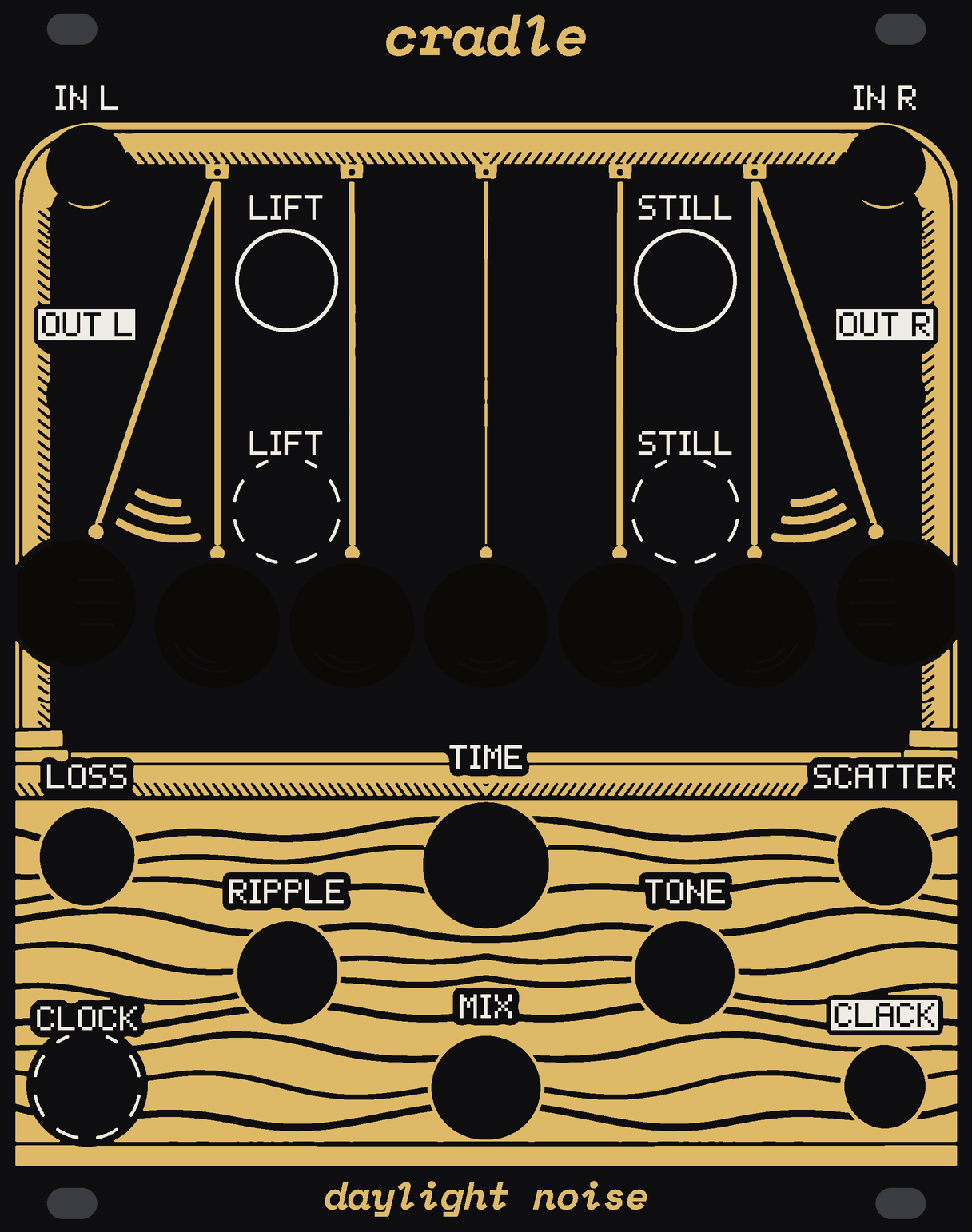
The CRADLE panel, black and gold: a bold hand-inked illustration in solid gold of a desk cradle seen front-on. One chrome tube, hatched in black ink on its shadow side, is bent into a rail across the top and a post down each side, with rounded corners; five long strings hang from small hangers under the rail, and the two end balls' strings are drawn a second time swung out to the top of their swing, with curved motion lines beside them. The five balls in a row across the middle and the two swung-out balls are bare glass, each shaded with a few ink strokes, the swung-out ones with speed lines. Below them a wooden base with bold flowing grain, a chrome cap along its top and a chrome foot, carries the knobs.

Turn a knob: drag it or tap either side of it, roll the wheel over it or use the arrow keys; a double click puts it back. Press LIFT to lift two balls; hold STILL to stop them. The patches step on until you touch anything.

Synthesised here: a stand-in rack plays a rimshot and a pluck into CRADLE; the kick, hats and bass go past it to the mixer.

example patches

CRADLE here is its engine as designed, in your browser: it hears only what comes into its jacks. The rimshot, the pluck, the kick, the hats and the bass are a stand-in rack.

Clack, clack

A delay plays your sound back a moment later: an echo. A ping-pong delay sends the echoes from side to side, left speaker, right speaker, left again. CRADLE does it the way a desk cradle of steel balls does. What you play goes in at the left ball. The right ball swings out and back and clacks: the first echo, on the right. That knock goes back through the row, the left ball swings out and back: the next echo, on the left. And so on, a little softer every time.

TIME, the big knob, is how long a swing takes. On its own it runs from 50 milliseconds to two seconds. Patch a clock into CLOCK (a pulse a beat) and TIME counts in beats instead: a sixteenth fully left, a beat at noon, a bar fully right, and it rests on the lengths you'd pick by ear (an eighth, a dotted eighth, a beat) as you turn it. Turn it while something's swinging and the echoes bend in pitch, like a tape's.

The ripple

Losing energy, losing order

Two balls, and a hand

Tone, mix and CLACK

In a rack

Specs

Format

Width
20 HP
Controls
a big knob (TIME), five knobs (LOSS, SCATTER, RIPPLE, TONE, MIX), two lit buttons (LIFT, STILL)
Lights
7 windows on 21 RGB LEDs: the five balls and the two swing places
Replaces
a clocked ping-pong delay, a multi-tap, a diffuser and a trigger out
Parts
a demo for now: the line's knobs, jacks and buttons, no board yet

Inputs

IN L
audio
IN R
audio, normalled to IN L
CLOCK
gate, a pulse a beat
LIFT
gate: two balls while high
STILL
gate: a hand on the balls while high

Outputs

OUT L
audio: your sound and the echoes
OUT R
audio: your sound and the echoes
CLACK
gate, 5 V for 4 ms at every clack