courtyard

every window a life

20 HP

Now and then it catches a bar of what you play and hangs it in a window across the yard, where it goes on looping, far off, in a small room of its own. LOOK is the long lens: one window comes close while the rest murmur behind it. One of them is up to something.

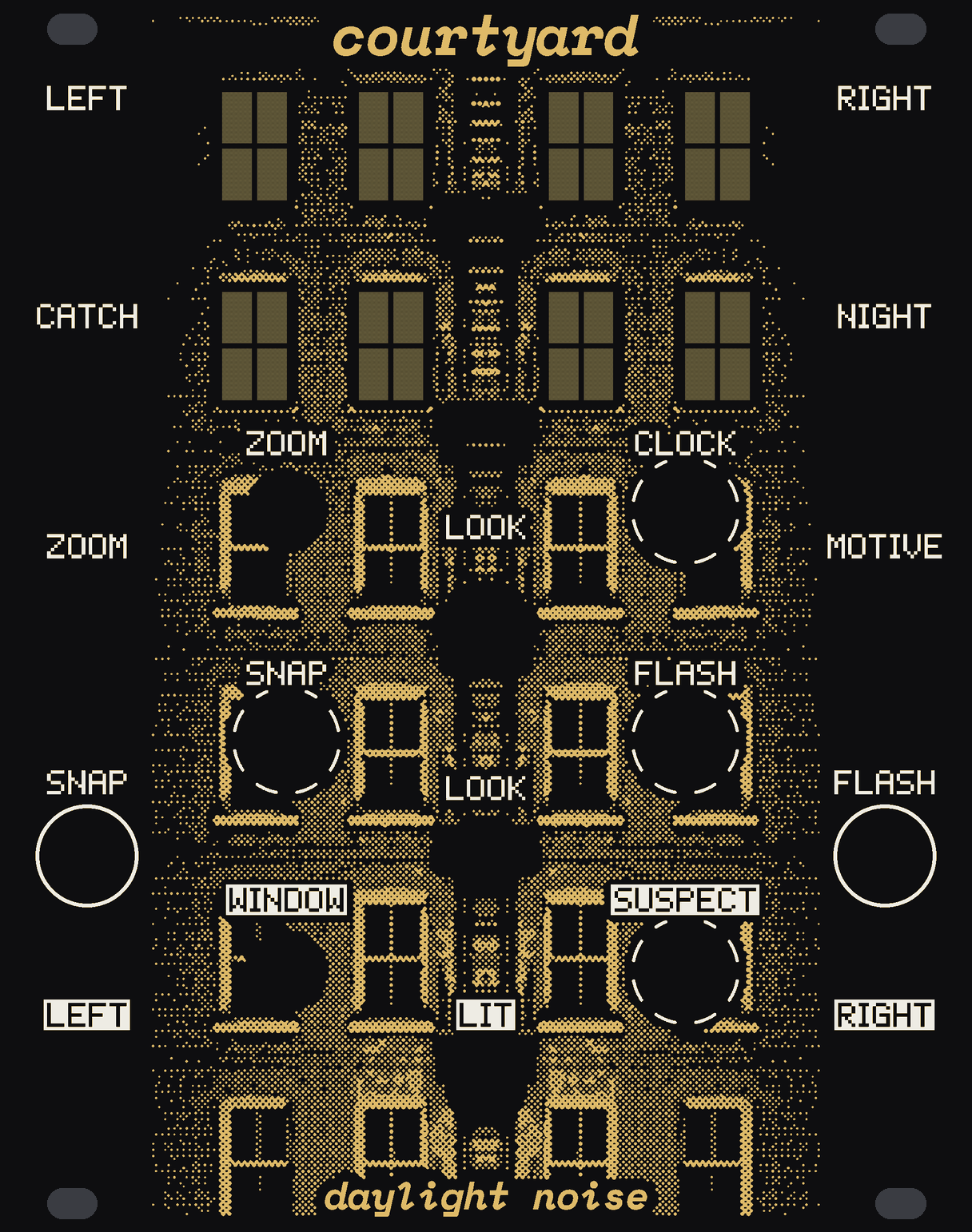
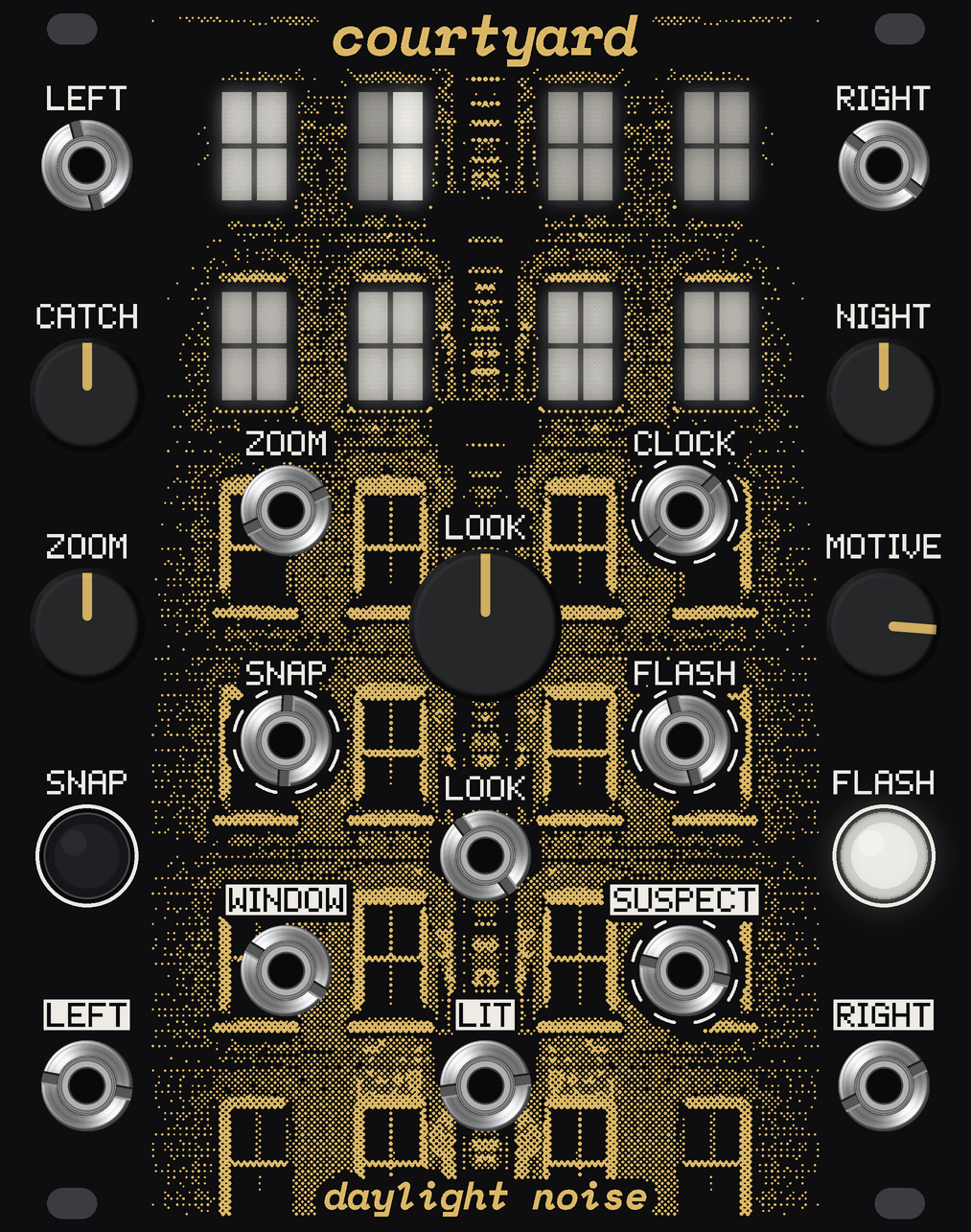
The COURTYARD panel: black, gold dots of the back of a brick block of flats at night, its fire escape down the middle; its top two floors are eight windows of bare circuit board, each in four panes. LEFT and RIGHT in at the top corners, CATCH and NIGHT under them, ZOOM and MOTIVE either side of the big LOOK knob, ZOOM's and CLOCK's jacks and SNAP's and FLASH's beside it, the SNAP and FLASH buttons lower, LOOK's jack under the knob, WINDOW and SUSPECT out, and LEFT, LIT and RIGHT out at the foot. courtyard at the top, daylight noise at the bottom.

Turn a knob: drag it or tap either side of it, roll the wheel over it or use the arrow keys; a double click puts it back. SNAP and FLASH are buttons: press them. The patches step on by themselves until you touch anything.

A dark track in A minor at 120 BPM, eight bars that each sound their own, through COURTYARD. Listen plays the patch from its top, the yard empty.

example patches

Everything COURTYARD does here is its engine as designed, running in your browser. The track is a stand-in rack.
The yard

Each window holds one bar of what you played, looping in time with the track, quiet, muffled and panned where it stands. The yard starts empty and fills a window a bar.

The lens

The night

What comes out

Inside

One board sits 10 mm behind the panel with everything on its front: the jacks, the knobs, both buttons, the 64 LEDs and the whole circuit, the USB-C in a notch in its left edge. Each pane has two white LEDs in its own cell of a black printed baffle, so a dark window beside a lit one stays dark. The bars are kept in 8 MB of memory beside an RP2350, which runs the yard on both its cores.

The COURTYARD panel at night: its eight windows lit across the top, one watched and brighter, a shadow crossing the suspect's, its knobs, jacks and buttons on.

Drag it or use the arrow keys to turn it; click it to take it apart.

Specs

Format

Width
20 HP
Depth
20.8 mm behind the panel
+12 V
about 75 mA dark, 155 mA in usual play, 250 mA at the flash, 265 mA at most (estimated)
−12 V
about 6 mA (estimated)
+5 V
not used
Controls
a big knob, 4 knobs, a lit button, a button

I/O

LEFT, RIGHT in
audio, ±5 V and up to ±9 V before it clips; RIGHT takes LEFT when it's empty
CLOCK
a pulse a beat, four to a bar, high past about 0.9 V; unpatched, its own 120 BPM
SNAP, FLASH
gates, rising past about 0.9 V; safe to ±12 V
LOOK, ZOOM
CV, added to the knobs, 5 V the whole way; safe to ±12 V
LEFT, RIGHT out
audio, the yard, up to ±9.75 V
WINDOW
audio, mono, the watched window alone
SUSPECT
trigger, 0/5 V, 10 ms
LIT
CV, 0 to 8 V, a volt a lit window

Engine

Brain
RP2350, both cores, at 46.875 kHz
Memory
8 MB: eight bars of up to 4 s (a bar at 60 BPM), 16-bit
Light
64 white LEDs behind 32 panes, 183 frames a second
Power cycle
the yard starts empty; only the calibration is kept