coppers

the pedal bends it

20 HP

Four kettle drums tuned to your chord. Strike them from four gates or let them play their own part on your clock; roll on one and it swells; turn the pedal and every drum bends while it rings.

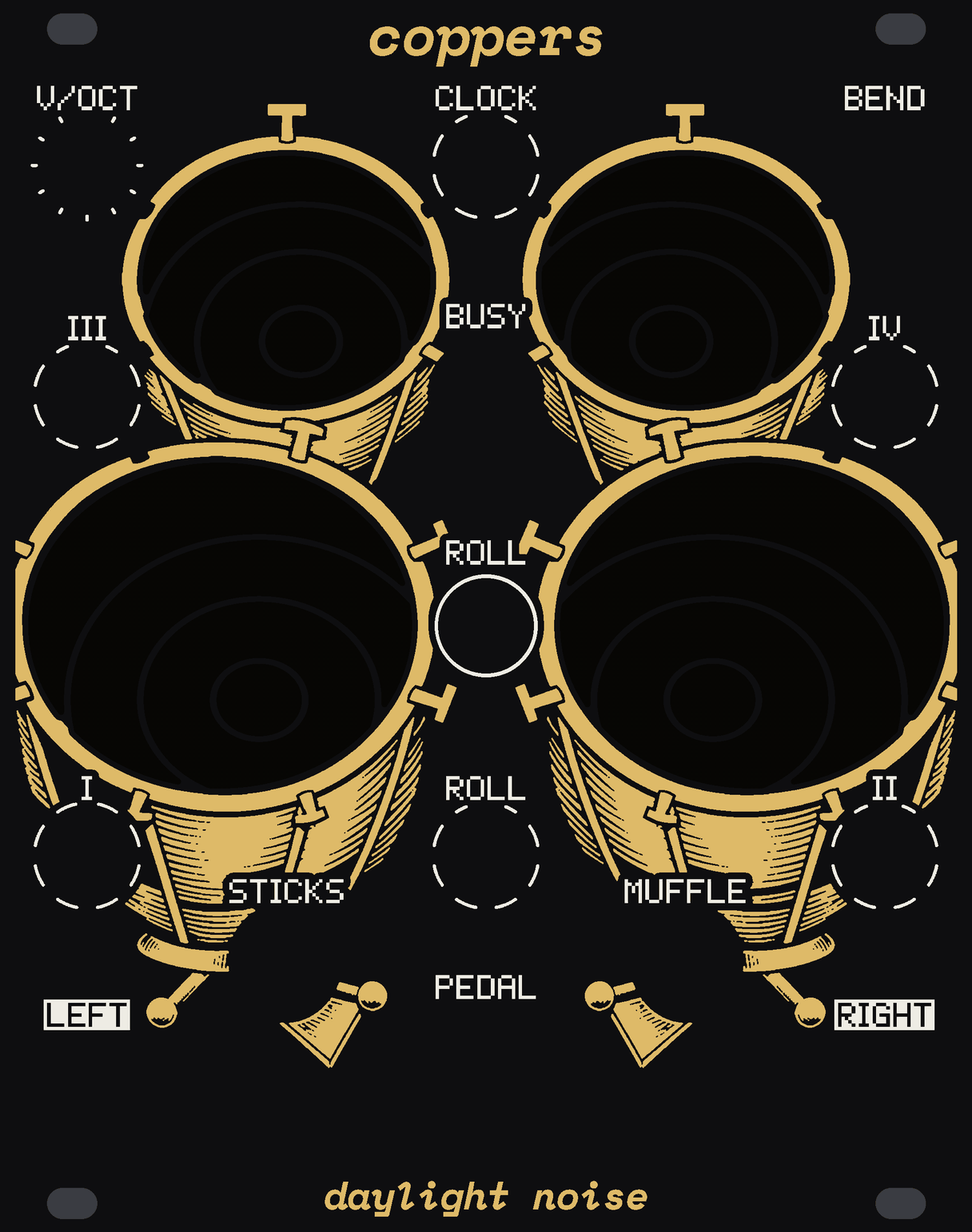
The COPPERS panel, black and gold: four orchestral kettle drums seen from high up, drawn in bold gold ink, two small ones behind and two big ones in front, each a round head inside its hoop of T-shaped tuning handles over a copper bowl shaded in curved hatching, with tension rods down its front; the big ones stand on bases with little legs and foot pedals at the bottom. The four heads are bare glass, each cut by thin black rings into the stick's spot and three bands round it. PEDAL, the big knob, at the foot between the pedals; BUSY between the small drums, the ROLL button between the four, STICKS and MUFFLE under the big drums; V/OCT, BEND, CLOCK, I to IV and ROLL in round them, LEFT and RIGHT out at the foot corners.

Turn a knob: drag it or tap either side of it, roll the wheel over it or use the arrow keys; a double click puts it back. Hold ROLL to roll on the drum struck last. The patches step on by themselves until you touch anything.

Synthesised here: the four kettle drums are COPPERS's engine; the strings, brass and snare round them are a stand-in rack, its clock, roots and gates patched in.

example patches

Everything COPPERS does here is its engine as designed, in your browser: the drums, their tuning, the strokes, the rolls and the pedal. The strings, brass and snare are a stand-in rack.

Four drums, tuned to the chord

Kettle drums are the orchestra's tuned drums: a calfskin head stretched over a copper bowl. The air in the bowl pulls the head's ringing into tune, so each stroke is a note, not just a thump, with its own glow of overtones over it and a soft boom under it. COPPERS makes four of them from the way a real one rings, two big ones and two small.

One cable tunes all four. Send a chord's root into V/OCT (a sequencer's note, say) and the big drum on the left, I, takes it, in its own low octave; II takes the note a fifth over it, the two small drums the same an octave higher. Root and fifth are in every major and minor chord, so the drums are always in tune with the song. Change the root and each drum's pedal slides it to its new note: a drum still ringing is heard to slide.

Striking and rolling

The pedal

Its own part

The heads

In a rack

Specs

Format

Width
20 HP
Controls
a big knob (PEDAL), three knobs (BUSY, STICKS, MUFFLE), a lit button (ROLL)
Lights
16 windows on 90 RGB LEDs: the four heads, each its spot and three bands
Replaces
four tuned drum voices, a quantiser, a trigger sequencer, a glide and an envelope
Parts
a demo for now: the line's knobs, jacks and buttons, no board yet

Inputs

V/OCT
1 V/oct: the chord's root; empty, D
BEND
CV: added to PEDAL, 5 V an octave
CLOCK
gate: a sixteenth a pulse; COPPERS's own part
ROLL
gate: rolls while high, its voltage how loud
I
gate: strikes the big drum on the left, the height how hard
II
gate: strikes the big drum on the right
III
gate: strikes the small drum on the left
IV
gate: strikes the small drum on the right

Outputs

LEFT
the drums as they stand, left; alone, the mono mix
RIGHT
the drums as they stand, right