combust

the stool's still warm

20 HP

A drum machine that goes through drummers. One at a time they play the kit on your clock, each with a feel of their own, and none of them lasts: mid-bar one dies, in flames or worse, the stool smokes, and the next counts in and carries the groove on.

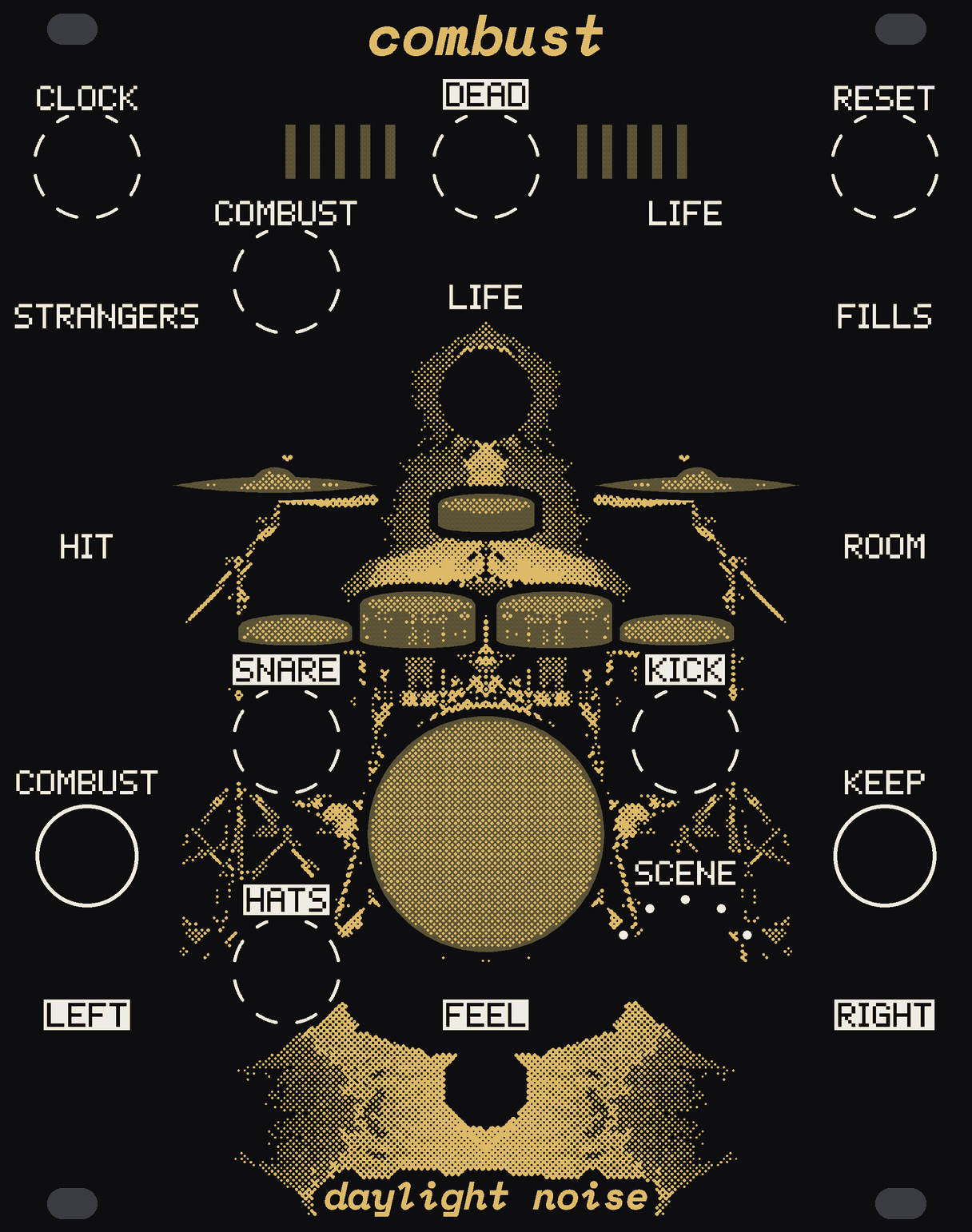
The COMBUST panel: black, gold dots of an empty drum stool in a spotlight on a dark stage, a thin smoke rising off it, the drum kit in front of it as windows of bare circuit board: the bass drum, four toms, two cymbals and the stool's seat. Ten tally strokes either side of DEAD under the name. CLOCK and RESET in at the top corners, COMBUST and LIFE in under them, STRANGERS and FILLS either side of LIFE, the big knob, HIT and ROOM beside the toms, SNARE and KICK out beside the bass drum, the COMBUST and KEEP buttons at the sides, HATS out and SCENE under them, LEFT, FEEL and RIGHT out at the foot. combust at the top, daylight noise at the bottom.

Turn a knob: drag it or tap either side of it, roll the wheel over it or use the arrow keys; a double click puts it back. SCENE clicks round its five worlds the same way. COMBUST and KEEP are buttons: press them. The patches step on by themselves until you touch anything.

A dark band in A minor at 124 BPM, its clock into CLOCK. Listen plays the patch from its top.

example patches

Everything COMBUST does here is its engine as designed, running in your browser. The band is a stand-in rack.
The drummers

The kit is the same all night. The person playing it isn't: each sits a little ahead of your clock or behind it, swings or doesn't, ghosts on the snare or doesn't, and has a fill and a count-in of their own.

How they play

The death and the count-in

Every drummer dies mid-bar, in a way of their own: in flames, the kit stopping dead; choking, their playing sagging to a halt; falling into the kit; or simply not there for the next hit. The stool smokes for a beat or more, then the next one counts in on the sticks and comes in on a bar line. The dead are tallied beside DEAD.

Past full

The last stretch of every knob goes too far, on purpose.

What comes out

Inside

One board sits 10 mm behind the panel with everything on its front: the jacks, the knobs, SCENE's switch, both buttons, the 45 LEDs and the whole circuit, the USB-C in a notch in its right edge. Each window has its own white LEDs in a cell of a black printed baffle, the bass drum's nineteen on rings so its head lights to the rim. An RP2350 runs the drummers four thousand times a second on one core and plays the kit on the other.

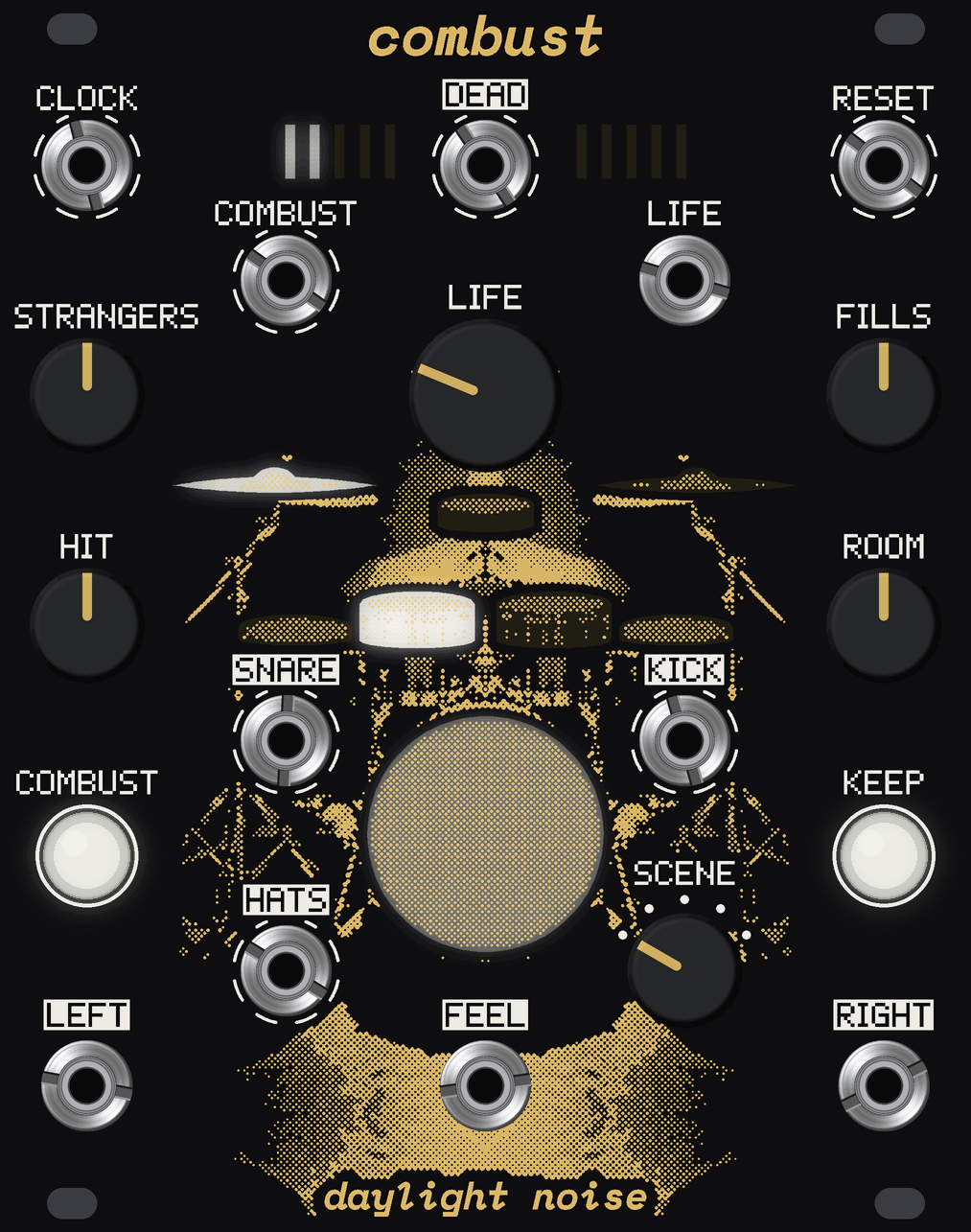
The COMBUST panel playing: the snare and the hats lit in the drum kit's windows, two strokes on the tally, the empty stool in gold dots behind the kit, its knobs, SCENE's switch and the COMBUST and KEEP buttons on.

Drag it or use the arrow keys to turn it; click it to take it apart.

Specs

Format

Width
20 HP
Depth
20.8 mm behind the panel
+12 V
about 50 mA dark, 145 mA playing, 225 mA at the most (estimated)
−12 V
about 5 mA (estimated)
+5 V
not used
Controls
a big knob, 4 knobs, a five-way switch, 2 lit buttons

I/O

CLOCK
a sixteenth an edge, high past about 0.9 V, safe to ±12 V; unpatched, its own 120 BPM
RESET, COMBUST
gates, high past about 0.9 V: RESET makes the next edge a downbeat, COMBUST kills on its rise
LIFE
CV, added to the knob, 5 V the whole way, read to ±7.5 V, safe to ±12 V
LEFT, RIGHT
the kit, about 2 V RMS at noon, straight to 6 V and softly to 8 V at the most
KICK, SNARE, HATS
triggers, 10 ms, 2.5 to 8 V by how hard
DEAD
gate, 0/5 V
FEEL
CV, 0 to 8 V

Engine

Brain
RP2350: the drummers 4,000 times a second, the kit at 46.875 kHz in 32-bit float
Light
45 white LEDs, 200 frames a second
Power cycle
a new first drummer at the first edge; only the calibration is kept