codec

a ghost on the radio

20 HP

A radio between you and a ghost. Everything you play is filed on the frequency you're tuned to, and when you go quiet something answers: what you played, rebuilt in a whispered voice, a little worse every time it's told. Turn the dial for old transmissions.

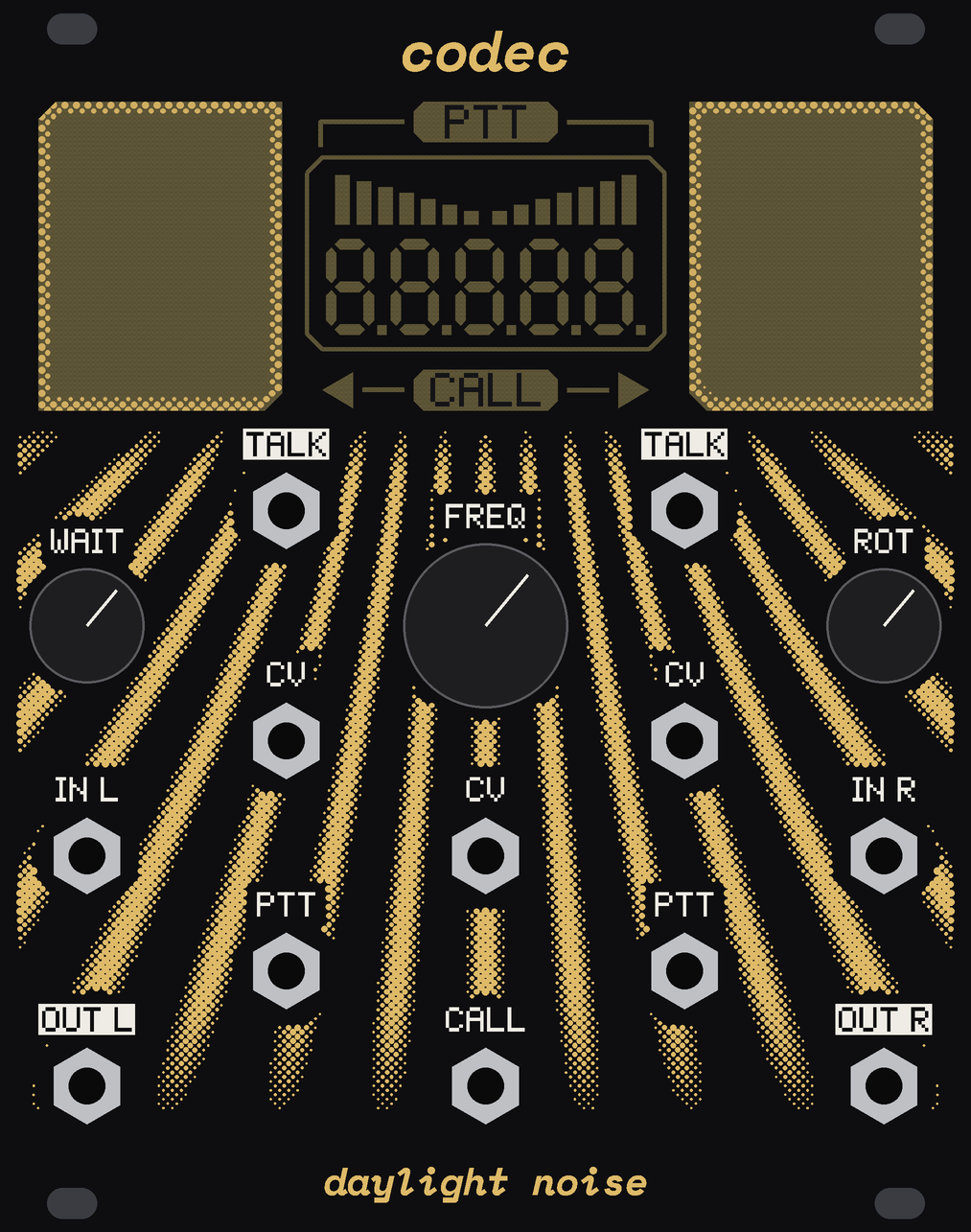
The CODEC panel, switched on. At the top, a screen of windows of bare glass: a portrait window each side, dark until that side talks, and between them PTT, level bars, a five-digit frequency and CALL with an arrow each side, the outline and the tabs lit green. Below, gold halftone fringes fan down the panel between WAIT, FREQ and ROT, and the jacks: TALK, WAIT, ROT and FREQ (each knob's CV), YOU and GHOST (the ins), PTT, LIVE and DEAD (the outs) and CALL, thin white dashes round the gates (TALK, PTT and CALL). codec at the top, daylight noise at the bottom.

Turn a knob: drag it or tap either side of it, roll the wheel over it or use the arrow keys; a double click puts it back. FREQ turns without end, a channel a click. Hold a PTT jack to key that side, and press CALL to ring.

Left is you, right is the ghost. Headphones help.

example patches

The module's own engine, running in your browser: the firmware's C, built for the page and checked against its desktop simulator sample for sample, playing the prototype's five demos as they were performed. Her voice is synthetic.

The ghost

CODEC remembers everything you play into YOU, the left input, but it doesn't record it. It keeps a sketch: the pitch, and the rough shape of the sound, a hundred times a second. That's about 2 KB a second, so it keeps hours of it, in flash, and it's still there after the power's been off.

Each thing you play is filed on the channel FREQ is tuned to. Go quiet for as long as WAIT says and the ghost answers on that channel. It rebuilds what it remembers in its own voice, breath and buzz pushed through the shape of yours, and sends it back over the radio. It's never the recording. Every retelling is saved over what it told, a little worse: smeared, drifting in pitch, more breath than voice. ROT says how fast. In the end you recognise the phrase without hearing it.

It's half-duplex, like a real radio: one side talks at a time. Turn WAIT below noon and the ghost stops waiting and talks over you. Both sides keyed at once is doubling: both voices chopped, and a squeal.

Patch GHOST, the right input, and the right side is a second voice instead of the ghost. Then CODEC is a plain two-way radio: two sources taking turns on one channel.
The screen

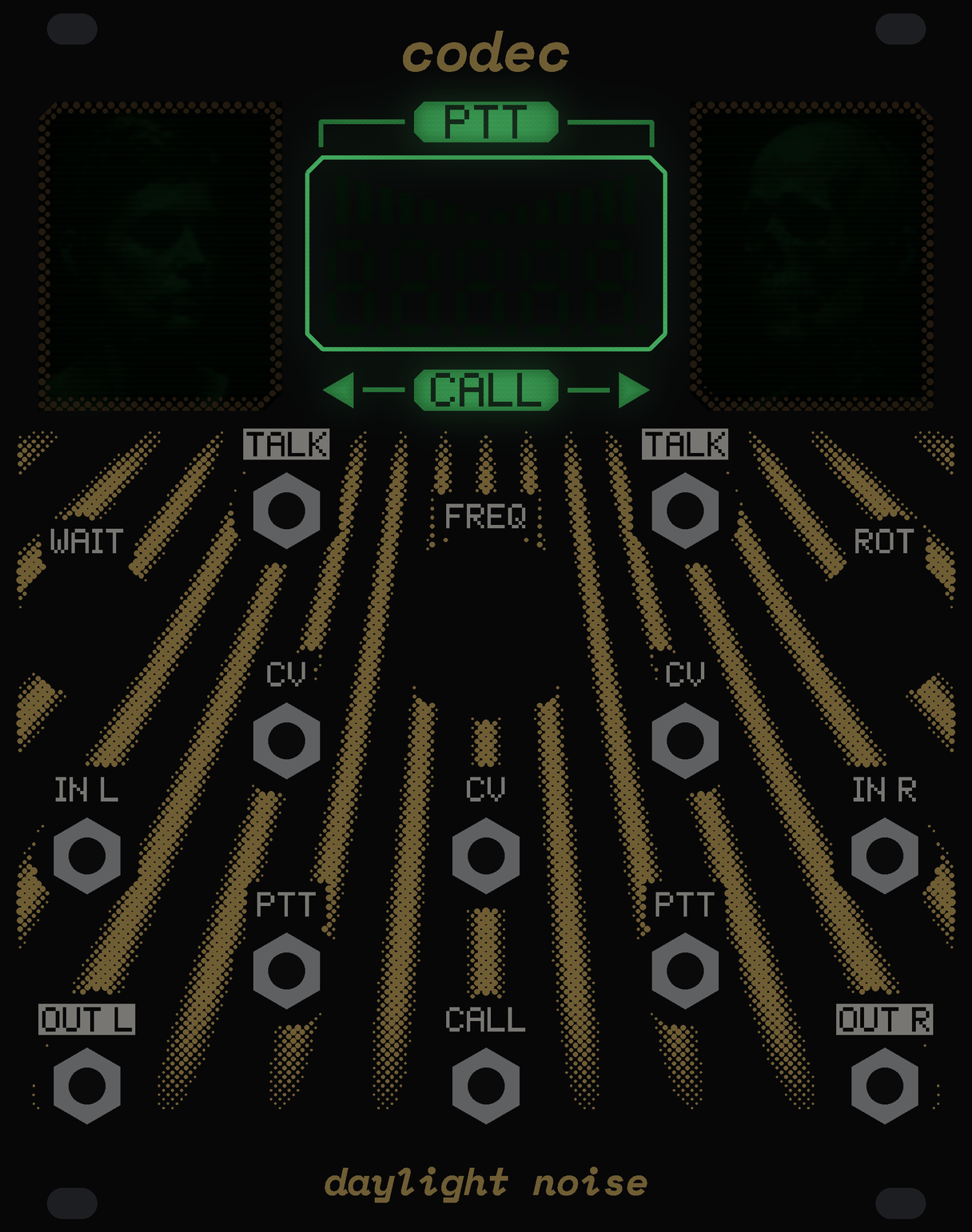
The top of the panel is lit from behind. Its windows are bare FR4, with no copper or mask on either side, over 76 RGB LEDs, each window in its own cell of a black printed baffle.

The two faces are printed on the back of the panel, in copper under black mask, as a line screen. With the module off they're black behind the glass against the black baffle: two blank screens. When a side talks, its window lights and the face comes up out of the light. Hers is your side. The ghost is her own skeleton, in her T-shirt and headset.

Inside

The CODEC panel lit: her face and the ghost's either side of the frequency, green, over gold halftone fringes.

Drag it or use the arrow keys to turn it; click it to take it apart.

Specs

Format

Width
20 HP
+12 V
about 200 mA, 250 mA at the most (estimated)
−12 V
about 10 mA (estimated)
+5 V
not used; 10-pin header
Controls
2 knobs and an encoder (FREQ, the big one)

I/O

YOU, GHOST
audio ins: YOU your side, GHOST the ghost's (or a second voice, patched): ±5 V with room to ±9; 100 k
PTT
two gate ins, one a side, rising past about 1.4 V; 200 k
CALL
trigger in, rising past about 1.4 V; 200 k
WAIT, FREQ, ROT
the knobs' CVs: ±5 V, FREQ's 10 channels a volt; 100 k
LIVE, DEAD
audio outs: LIVE the live side's receiver, DEAD the ghost's; ±5 V; 1 k
TALK
two gate outs, high while that side holds the channel, 0 or 5 V; 1 k

Engine

Brain
RP2350 at 144 MHz, both cores, 46.875 kHz
Converters
PCM1808 in, PCM5102A out, on one I2S clock
Memory
16 MB flash, kept through power-off; about 2 KB of sketch a second
Sketch
pitch and 16 bands, every 10 ms
Screen
76 RGB LEDs behind a printed baffle, their current capped
Firmware
over USB-C, set into the board's edge, or the debug header on the back