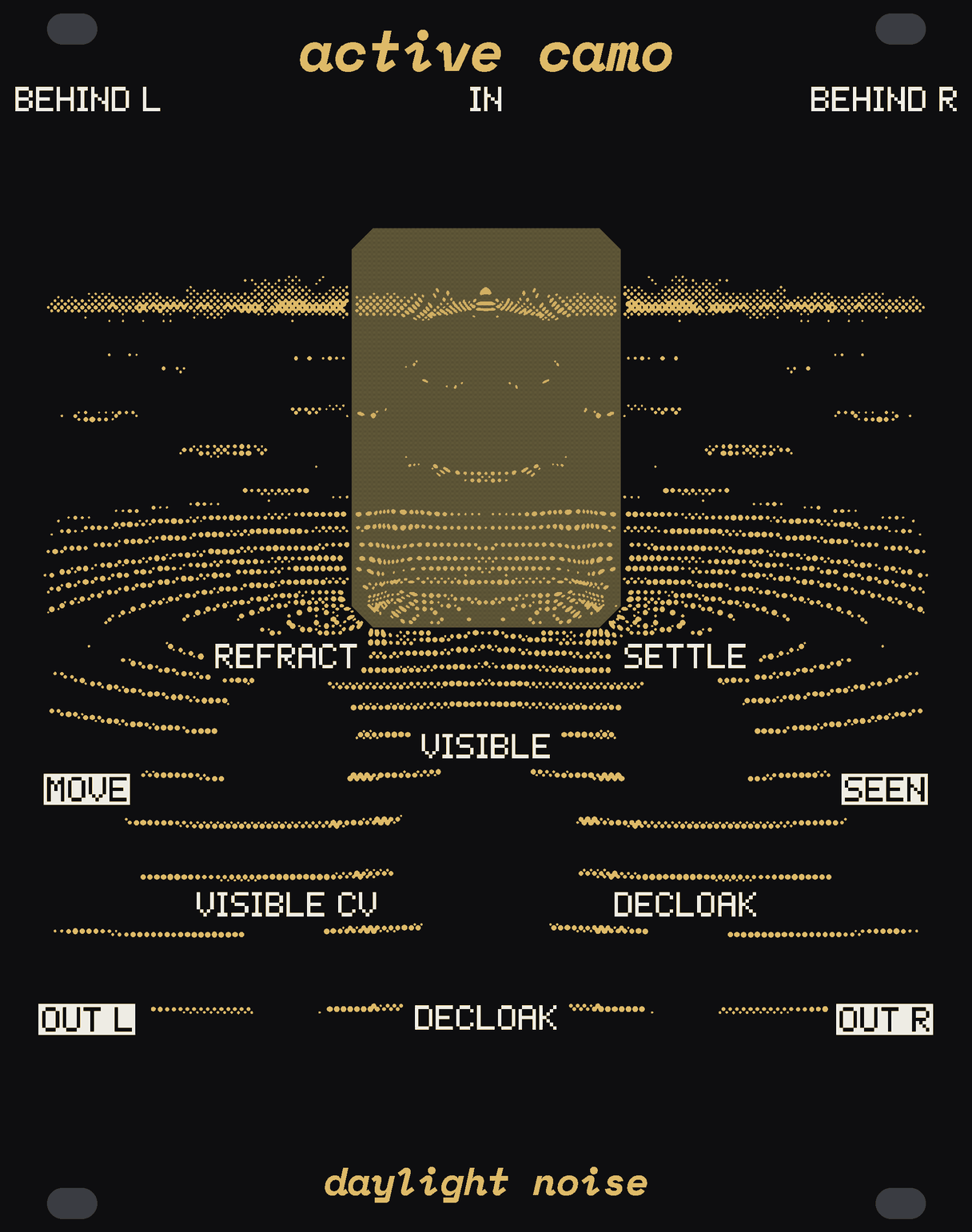
20 HP · a cloak for a sound
Patch a sound into IN and the mix it stands in front of into BEHIND, and the sound disappears into the mix. All that's left of it is the mix bending round its edges whenever it moves: at a consonant, a chord change or a hit, a ripple in its shape, made of the mix itself. When it holds still, it's gone. VISIBLE and a DECLOAK button make the cloak fail, band by band, until the sound stands there plain.
Turn a knob: drag it, roll the wheel over it or use the arrow keys; a double click puts it back.
example patches
The engine running here is CLOAK's firmware, the code the module runs, in the page; the rack round it, the track and its bodies, is made in the page too. The figure is lit by the engine. Hold DECLOAK down to make the cloak fail.
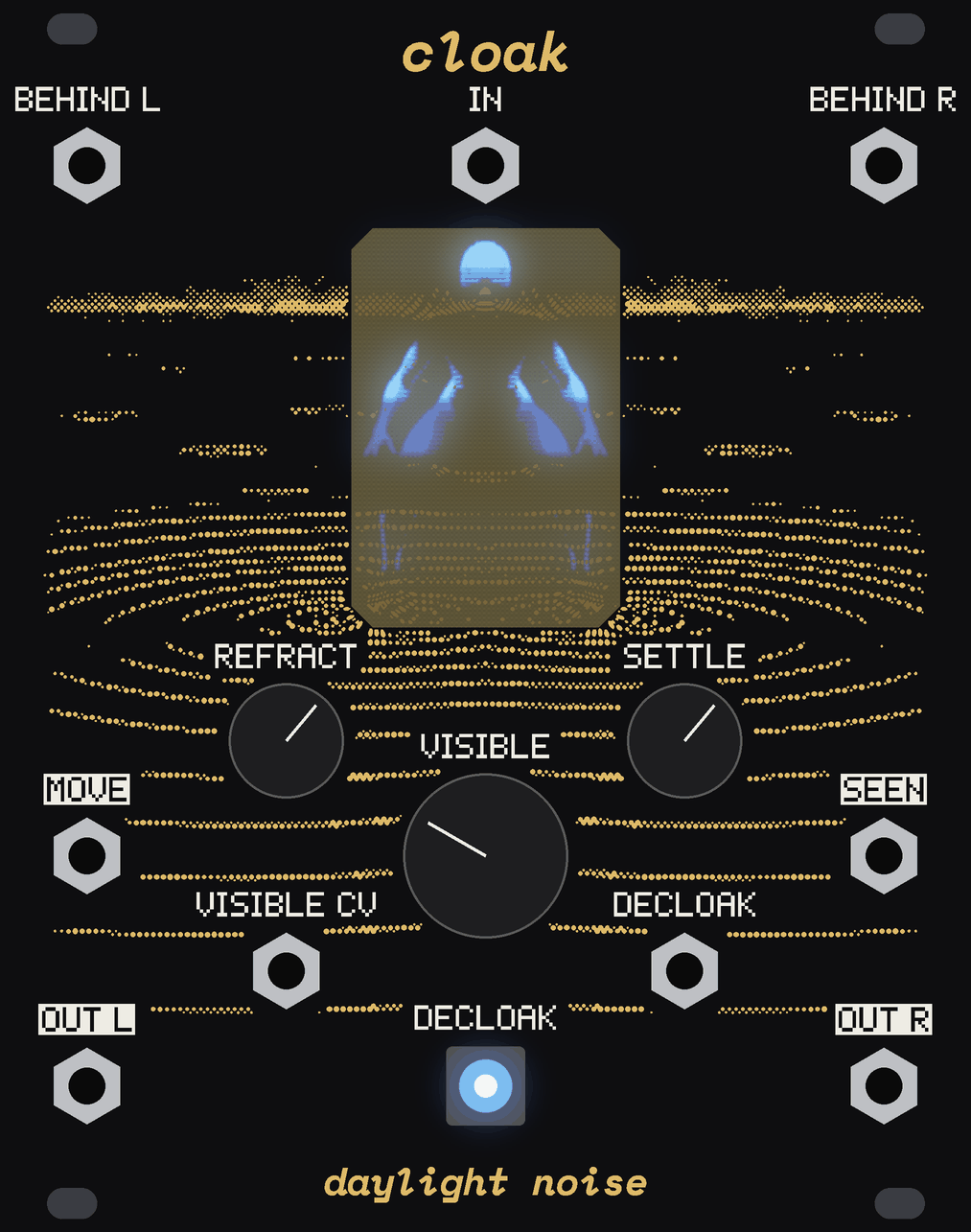
The mix at BEHIND goes through CLOAK to OUT, in stereo. When nothing moves it comes out exactly as it went in, 27 ms late. The sound at IN, the body, never reaches OUT on its own while the cloak is on: it lives inside the mix as a distortion of it.
In each band two followers track the body's level: a fast one, a few milliseconds behind, and a still one that takes SETTLE to catch up. When they disagree by more than 3 dB the band is moving, fully at 18 dB. A held note has nothing to show once the still follower has caught it; an onset, a consonant or a chord change pulls them apart in exactly the bands that changed. That's the difference from a vocoder, which lays one sound's shape over another all the time: CLOAK only shows a sound's movement, and only as the mix bending.
REFRACT is what the bending sounds like, in the moving bands and nowhere else.
SETTLE is how long the body has to hold still to vanish, from 30 ms to 2 s. Down low only hits and consonants show, and a sung vowel is gone almost as soon as it starts. Up high, everything that's changed lately shows, smeared: a voice talking quickly keeps the mix rippling the whole time.
VISIBLE makes the cloak fail. At 0 the body is never heard. As it rises, each of the body's bands flips between hidden and shown at random, 20 to 60 ms apart, shown more often the higher VISIBLE is, the highs first, so the reveal runs from the top down. Where bands are failing there's crackle, short crushed fragments of the body. At 1 the body is plain and nothing is bent. VISIBLE CV adds to the knob, 5 V for its whole travel.
DECLOAK, a button and a gate in, is the reveal: while it's held VISIBLE sweeps to the top in 300 ms, through the crackle, and back in 600 ms when it's let go. Gate it for a chorus and the hidden voice fails into view on the drop.
MOVE is the body's movement as a voltage, 0 to 8 V: it jumps on every onset and falls away with SETTLE, an envelope of change rather than of level. SEEN is a gate, high while MOVE is over 3 V and low again under 2 V: the moments someone looking would catch it. In the last example patch, MOVE opens the bass and SEEN plays an open hat.
Twenty HP, every part on the line's staggered grid and mirrored about the middle. The art is shallow black water at night in gold dots, ripples spreading from two footsteps nobody is making. In the middle is a window of bare FR4, and printed on the back of the panel behind it, in copper under black mask, is a figure crouched in the water, a ripple's centre under each foot. Unlit, you can't see it: there's only a pane in the dark.
Twenty-one blue LEDs light it from behind, three to each of seven bands from the head to the feet. Each band lights as much as the body's bands it stands for are shown, the highs at the head, so the reveal runs down the figure and the failing breaks it up. While it's cloaked it glints faintly when the body moves. DECLOAK's button lights with its sweep.
Drag to look around. Lift the panel: the baffle stays on the board, seven cells over their LEDs, glowing as the figure is lit. One RP2350 does it all, its two cores sharing each frame.
CLOAK is designed and its firmware builds. Nothing has been made, so the numbers here are the design's and the engine's, not measurements, and there's no date.