cliffhanger

to be continued

20 HP

A tune that tells stories within stories. Its words open doors into shorter tales grown from it, three deep, and each comes back out. When the night runs out it stops mid-word, and the next night picks up exactly there.

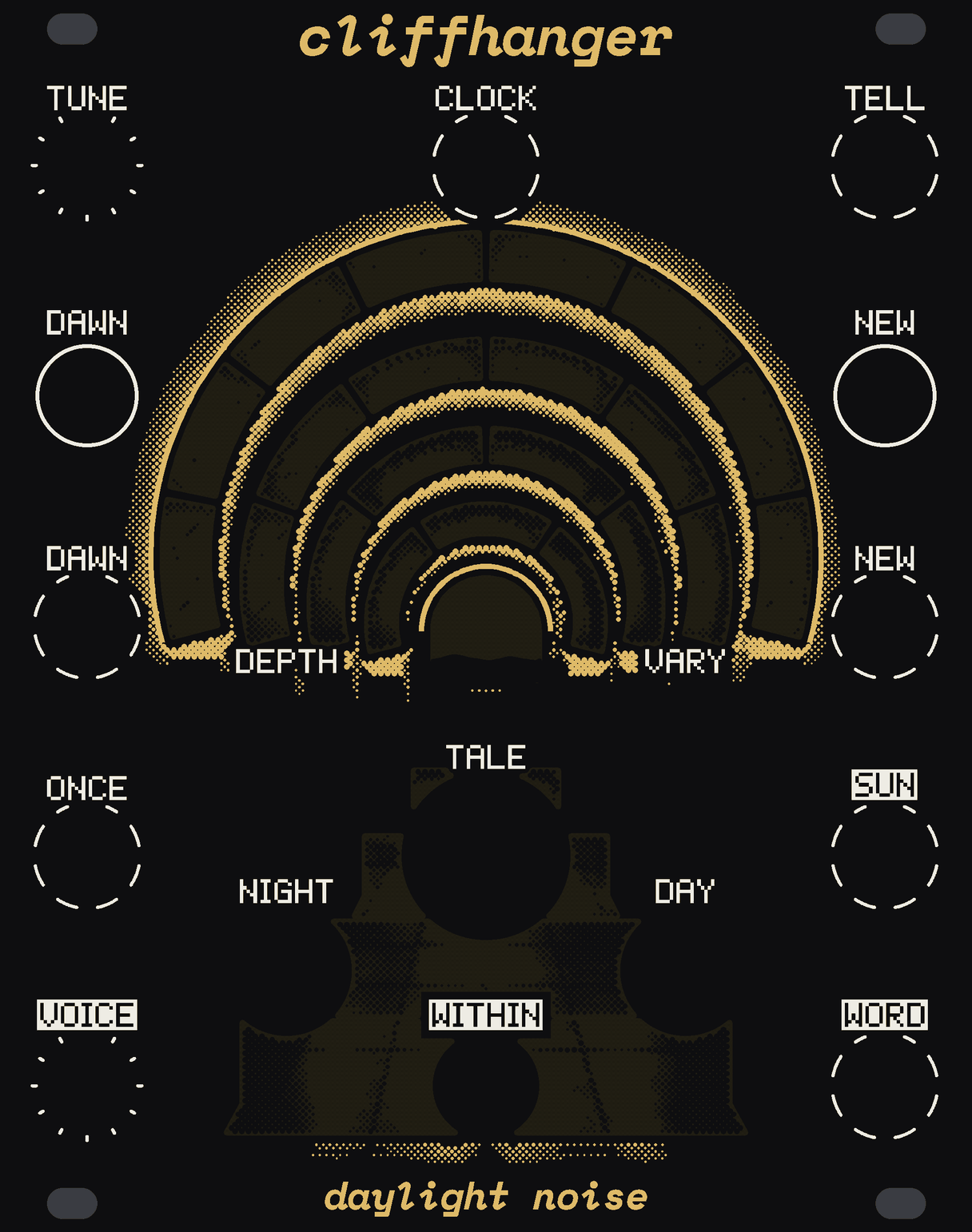
The CLIFFHANGER panel, black and gold: a photograph in gold halftone of four horseshoe arches in a palace at night, each standing further back and smaller than the one before it, nested one inside the next, their undersides carved and gilded and fading into the dark between them. Every arch's carved stones are bare glass for light: eight in the outer arch, six, four and three going in. At the far end, inside the smallest arch, a round-topped window on a pale sky over low black hills; the floor of each room is glass too, running in toward it. TALE, the big knob, stands on the floor before the arches; the jacks, the other knobs and two lit buttons stand on the walls either side.

Turn a knob: drag it or tap either side of it, roll the wheel over it or use the arrow keys; a double click puts it back. Press DAWN to stop the tale mid-word (and again for the next night), NEW for a new tale. The patches step on by themselves until you touch anything.

Synthesised here. CLIFFHANGER makes no sound: you're hearing a stand-in rack, its clock in CLOCK and the module's outs playing its harp, its echo and its drums.

example patches

Everything CLIFFHANGER does here is its engine as designed, in your browser: the tale, its doors and stories, the nights and the days. The harp, the drum, the bass, the pad and the room are a stand-in rack.

Stories within stories

The tale is eight notes, one a clock: a short phrase, like any sequencer's. Patch a clock into CLOCK and VOICE and WORD into a voice, and it plays.

Then turn up TALE. Now some of its notes open a door. The note is played, and then a shorter phrase is told inside it: a story within the tale, made from the tale itself. A story can open a door of its own, and that one too, three deep. When a story ends, the tale comes back out to the note after the door it went in by.

So one eight-note phrase becomes a long one with a shape: it goes in, wanders, and finds its way home. And it's the same shape every time round at the same setting, so you can learn it.

The doors

Dawn

Telling it a tale

In a rack

Specs

Format

Width
20 HP
Controls
a big knob (TALE), four knobs (DEPTH, VARY, NIGHT, DAY), two lit buttons (DAWN, NEW)
Lights
26 windows on 84 RGB LEDs: the four arches' 21 stones, the floor of each room, the dawn window
Replaces
a sequencer, a phrase-variation sequencer, a song arranger that nests and returns, and a break generator
Parts
a demo for now: the line's knobs, jacks and buttons, no board yet

Inputs

CLOCK
gate: a note on each rising edge; empty, a note every 0.3 s
TUNE
1 V/oct: the pitch you tell it
TELL
gate: each a note you tell it
DAWN
gate: dawn now; by day, the next night
NEW
gate: a new tale
ONCE
gate: back to the tale's first note

Outputs

VOICE
1 V/oct, the note being told
WORD
5 V, a gate a note; none by day
SUN
5 V all day
WITHIN
0 to 5 V, how deep the story is