carriage

ding, and a new line

20 HP

A sequencer that types its tune a line at a time. A bell rings four steps before the end of every line, the carriage comes back, and the next line is the same one typed again, with a slip or two in it.

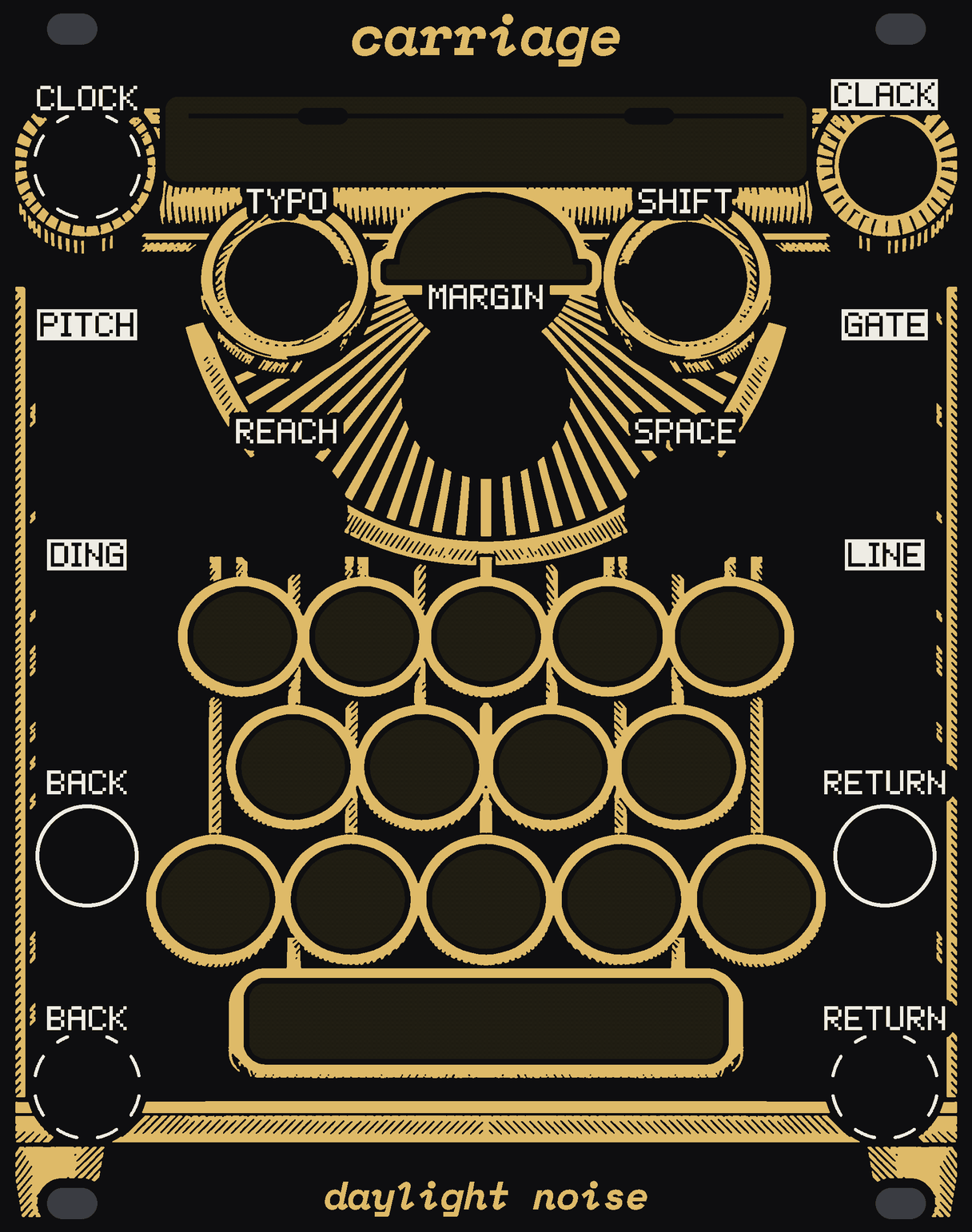
The CARRIAGE panel, black and gold: an old manual typewriter seen from the front and a little above, drawn in bold gold ink. Across the top the carriage: a ribbed platen with a knurled knob at each end and a strip of paper in front of it, held by its bail. Under the paper a small domed bell on the centre line, and below it the half-round fan of typebars spreading down to their segment, a ribbon spool either side. Then fourteen round keys on their levers in three rows, five, four and five, each in a bright rim, and the space bar across the front; the frame's sides and its plinth with two feet at the foot. The paper, the bell, the key tops and the space bar are bare glass for light.

Turn a knob: drag it or tap either side of it, roll the wheel over it or use the arrow keys; a double click puts it back. Press BACK to backspace and RETURN for a new line; shift and click RETURN for a new sheet, BACK for the keys' next tuning. The patches step on by themselves until you touch anything.

Synthesised here. CLACK is CARRIAGE's own sound, the keys, the bell and the return; the vibraphone, the piano, the bass and the drums are a stand-in rack its jacks are patched to.

example patches

Everything CARRIAGE does here is its engine as designed, in your browser: the typing, the slips, the bell, the returns and its own clack. The vibraphone, the piano, the bass, the congas and the room are a stand-in rack.

A line at a time

CARRIAGE plays a tune the way a typewriter types a letter. Every clock into CLOCK is a keystroke: a key (a note on PITCH and GATE) or a space (a rest), and the carriage moves a place along the line. Patch PITCH and GATE into a voice and it plays.

Near the end of the line a bell rings, four places before the margin. The typist finishes the word, the carriage comes back, and the next line begins. It's the same line typed again, but not quite: a finger slips onto the next key here, a capital there. The slips stay in, so every line is the last one with its mistakes, and the tune drifts a key at a time.

So it plays phrases, not a loop: a line, a breath, a line a little different. And you hear the end of each one coming.

The bell and the return

Slips, capitals and BACK

The keys and the spaces

In a rack

Specs

Format

Width
20 HP
Controls
a big knob (MARGIN), four knobs (TYPO, SHIFT, REACH, SPACE), two lit buttons (BACK, RETURN)
Lights
17 windows on 33 RGB LEDs: the paper, the bell, fourteen keys, the space bar
Replaces
a step sequencer, a mutating looper, a phrase counter with an early warning, and a small percussion voice
Parts
a demo for now: the line's knobs, jacks and buttons, no board yet

Inputs

CLOCK
gate: a keystroke on each rising edge; empty, 8 a second
BACK
gate: a backspace on each rising edge
RETURN
gate: the return; patched, the typist waits for it

Outputs

PITCH
1 V/oct, the key's note
GATE
5 V, half a step on each key
DING
5 V from the bell to the return
LINE
5 V, 15 ms at each return
CLACK
audio, the machine's own sound, about 3 V peaks