callsign

anyone still out there

20 HP

Two real FM radios in the rack, a patch cable for an aerial. It hops your town's stations faster than you can follow: broken syllables, half a chord, then static. A channel is a semitone, so your town is a scale. When it finds a human voice it can stop and listen.

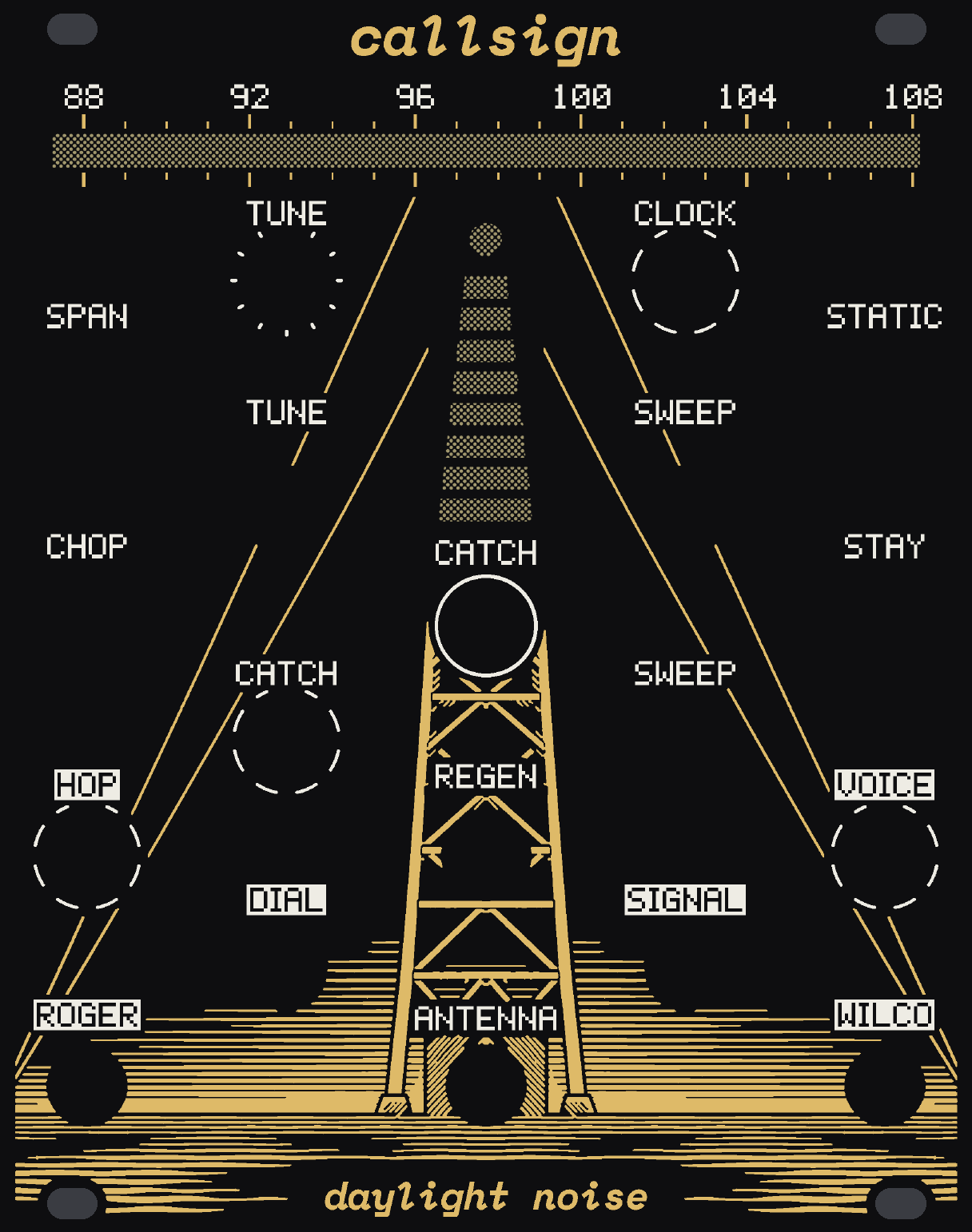
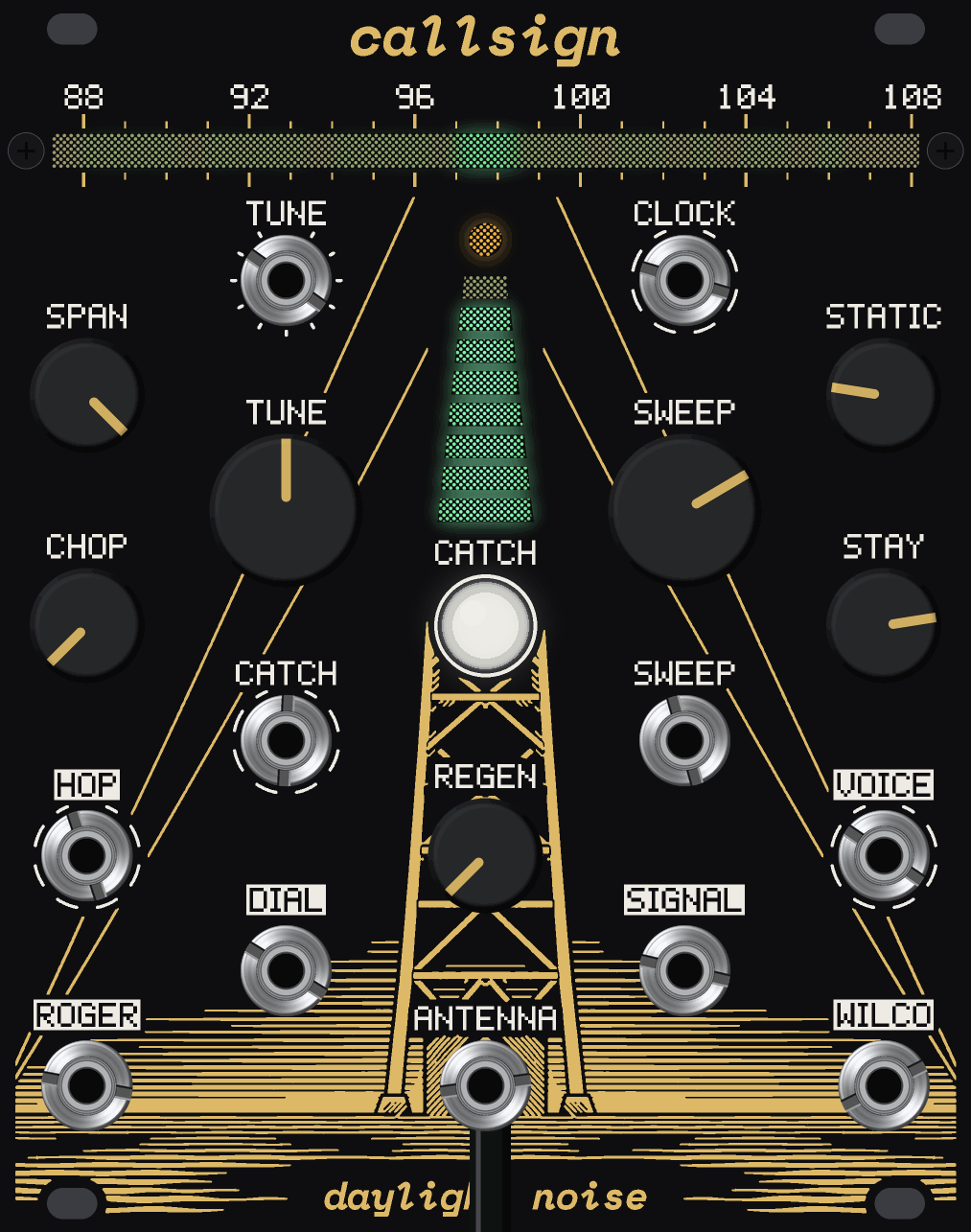
The CALLSIGN panel: black, a long strip of bare circuit board across the top under the name, marked 88 to 108 in gold ticks; below it a steel radio mast drawn in ink, solid gold with black cross-braces, rising from the ANTENNA jack at the foot out of fog drawn as long level gold lines, its top section eight bare rungs and a round lamp; TUNE and SWEEP the two big knobs either side of the mast, the jacks and small knobs round them; daylight noise at the foot.

Turn a knob: drag it or tap either side of it, roll the wheel over it or use the arrow keys; a double click puts it back. CATCH is a button: press to hold the last two seconds, again to let go. The aerial is the loose plug under the panel: drag it anywhere, hold it and your hand's on it, let go and it swings. Tab to it and the arrow keys push it, Space takes hold. The patches step on until you touch something.

A made-up town's twenty-four stations, and each patch its own band round them. The real one hears yours.

example patches

The dial, the map, the sound and every out and light here are CALLSIGN's engine, the module's own code, running in your browser. Only the air is made up: synthesised talk and music, a model of the radio and the cable. This town's stations sit in A minor; yours won't.
The aerial

Plug any patch cable into ANTENNA and leave the other end loose. A longer one should hear further. Hung clear it should hear best; laid against the rack it's likely to hear the rack's own clocks too. Indoors every station has its strong and weak places, so moving the cable can fade one as another arrives. Hold it and you become part of the aerial, which should change what it hears.

The dial

Switched on, it walks the band in about four seconds, and each station it finds stays on the dial as a faint mark. The bright needle is the radio you hear; the dim one is the other, already at the next stop, so a hop has no gap.

Someone there

Its own note

Catch

It always keeps the last two seconds. Catch them and a real voice from just now is held. The needle walks on, but every stop now plays the fragment at its own pitch, so a sequence that was hopping stations plays the same notes on what you caught.

What comes out

Inside

The CALLSIGN panel: a steel radio mast drawn in solid gold rising from ANTENNA's jack, its ladder lit and the lamp at its top on, a lit tuning dial across the top, its knobs, jacks and CATCH on.

Drag it or use the arrow keys to turn it; click it to take it apart.

Specs

Format

Width
20 HP
Depth
20.8 mm behind the panel
+12 V
about 105 mA dark, 125 mA in use, 135 mA at the most (estimated)
−12 V
about 8 mA (estimated)
+5 V
not used
Controls
2 big knobs, 5 knobs, a lit button
Lights
46 RGB LEDs: the dial, the ladder and the lamp

The radio

Receivers
two Si4732, mono, one on air, one ahead
Band
87.5 to 107.9 MHz, 103 channels 200 kHz apart
Region
Australia or the Americas (50 or 75 µs de-emphasis), set over USB
Finest step
20 kHz
A hop
3 ms crossfade, about 60 ms between real hops
Memory
the last 2 s

Inputs

ANTENNA
a patch cable, its other end loose
Audio
none: it plays only the air
TUNE
1 V an octave, ±6 V, added to its knob
SWEEP
CV, 5 V the whole way, added to its knob
CLOCK
clock: the next stop, high past about 0.9 V, a pulse every 8 s or faster
CATCH
gate: holds while it's high, past about 0.9 V

Outputs

ROGER, WILCO
audio, left and right, ±5 V
DIAL
CV, ±4.25 V, 1 V an octave
SIGNAL
CV, 0 to 8 V
HOP
trigger, 5 V, 10 ms
VOICE
gate, 5 V