bulwark

takes the hits

20 HP

A stereo compressor with a shield. It holds your drums down tight, and every hit it holds costs it charge. Hit it hard enough for long enough and the shield breaks: the hits punch through raw. Give it a moment of quiet and it hums back up.

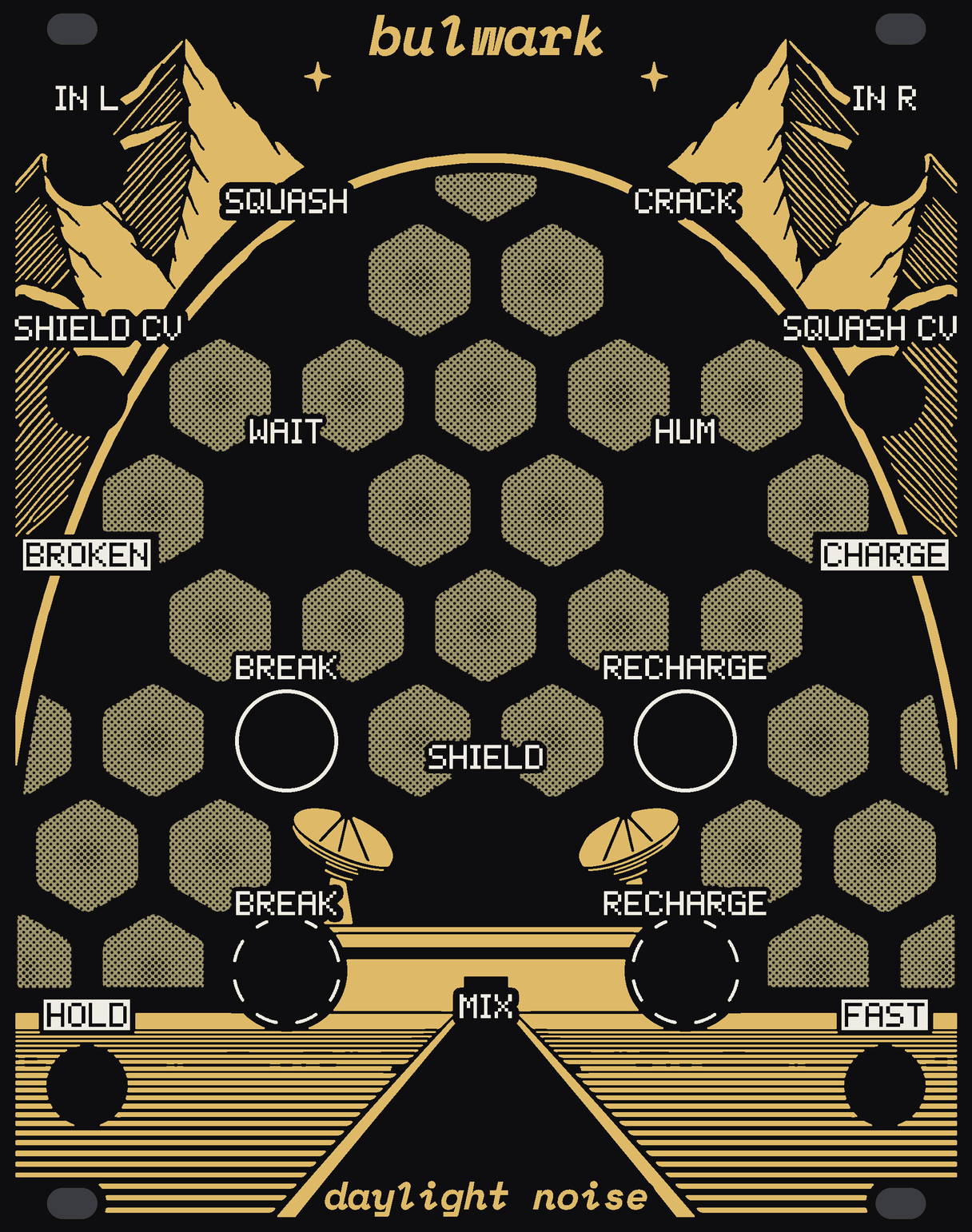
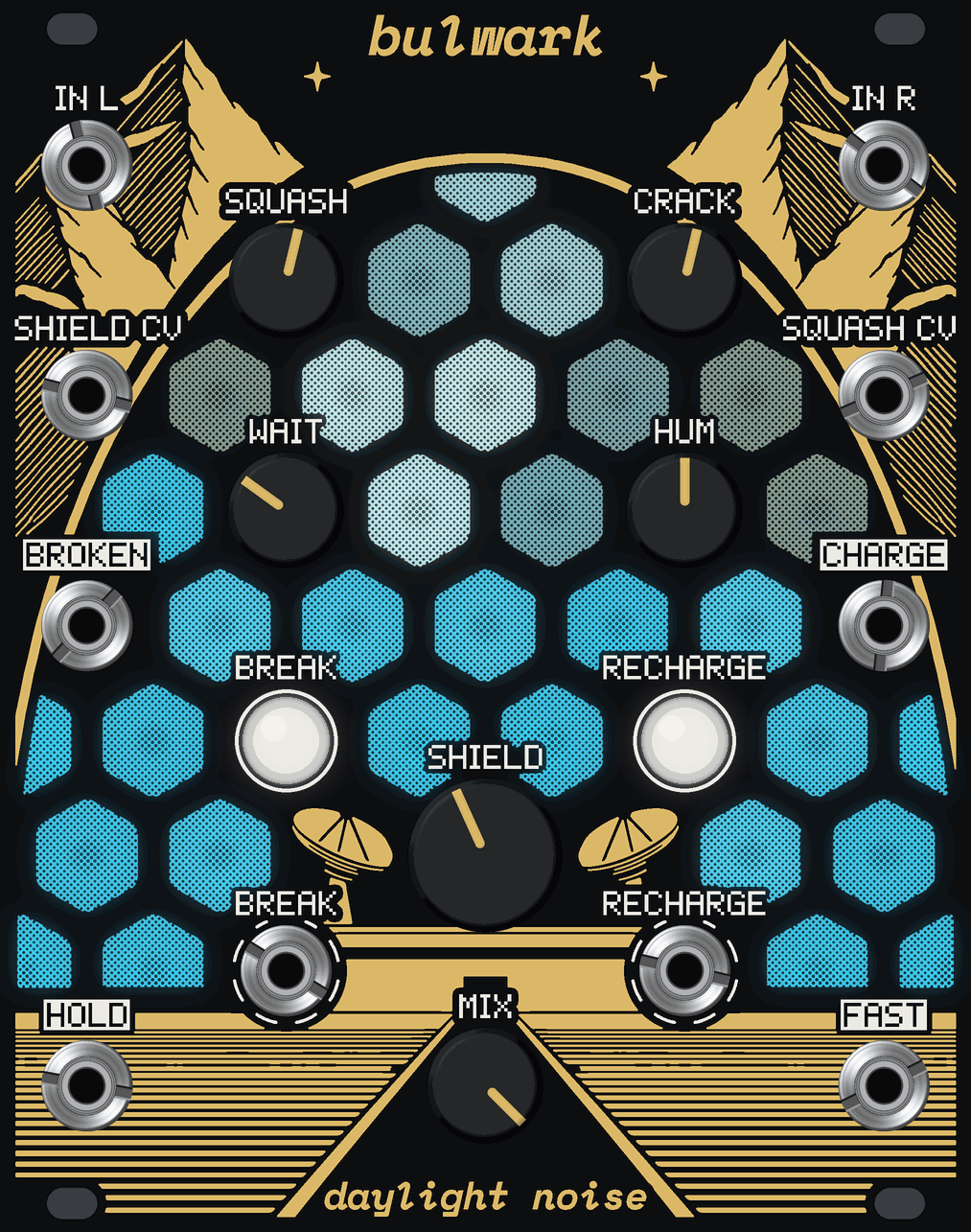
The BULWARK panel, black and gold: a drawing at night of a dome of light standing over a lone outpost on a plain between two snow peaks, filling the panel. The peaks, the plain and its road, two stars and the outpost, a low bunker with a radar dish on a post either side, are inked in solid gold, their shadows hatched in black lines, and the dome's edge is one gold line. The dome itself is a honeycomb of 31 hexagonal tiles of bare glass, each dotted dark in its middle and bright round its rim, with the knobs, buttons and jacks sitting in the gaps of the honeycomb. The big SHIELD knob is on the bunker's roof between the two dishes; SQUASH and CRACK, WAIT and HUM, and the BREAK and RECHARGE buttons over their gates are inside the dome; the ins and the two CVs are up in the sky at the corners, the outs and MIX on the ground at the foot, HOLD and FAST either side of MIX.

Turn a knob: drag it or tap either side of it, roll the wheel over it or use the arrow keys; a double click puts it back. Press BREAK and the shield breaks; press RECHARGE and it charges back up. The patches step on by themselves until you touch anything.

Synthesised here, as the module would make it: the hold, the charge, the break and the hum, round a stand-in rack's drums.

example patches

Everything BULWARK does here is the module's own engine in your browser, every sample the same: the hold, the charge, the break and the hum, and it hears only what comes into its jacks. The drums, the band round them, the beeps and the gates are a stand-in rack.
One cable, a shield

Put your drums through it: IN L and IN R in (one cable does both), and out of HOLD (the left side) and FAST (the right) to your mixer. Only one cable out? Plug it into HOLD: with one cable in, both carry the same sound. The shield holds them down like a firm, fast compressor on a drum bus: the loud hits come down to meet the quiet ones, and the kit sits together. The tiles are the shield.

Every hit costs charge

When it breaks

Charging back up

SQUASH and MIX

BREAK and RECHARGE

Inside

The BULWARK panel holding: the shield's tiles lit cyan from the foot up, a hit's ring running out over them.

Drag it or use the arrow keys to turn it; click it to take it apart.

Specs

Format

Width
20 HP
Depth
20.6 mm behind the panel
+12 V
about 80 mA dark, 115 to 150 mA playing, 160 mA at the most (estimated)
−12 V
about 6 mA (estimated)
+5 V
not used
Controls
six knobs (SHIELD, SQUASH, CRACK, WAIT, HUM, MIX), two lit buttons (BREAK, RECHARGE)
Light
31 RGB LEDs under the shield's 31 glass tiles
Replaces
a stereo bus compressor, a transient shaper with drive, and an envelope follower's gate

Inputs

IN L
audio to ±10 V: the left side (both sides with nothing in IN R)
IN R
audio to ±10 V: the right side
SHIELD CV
added to SHIELD: 5 V the whole turn
SQUASH CV
added to SQUASH: 5 V the whole turn
BREAK
gate: the shield breaks on the rise
RECHARGE
gate: it charges back up on the rise

Outputs

HOLD
audio: the left side, 4.2 ms after it came in (the one for a single cable)
FAST
audio: the right side
BROKEN
gate: 8 V while the shield is broken
CHARGE
CV: the charge left, 0 to 8 V

Engine

Brain
RP2350 at 144 MHz, 46.875 kHz: this page's engine, every sample the same
Memory
under 4 KB of the chip's own: 2 ms of look-ahead a side, nothing recorded
Updates
over USB, the panel left on