buckets

it won't stop carrying

20 HP

A real analogue echo and chorus: thousands of tiny capacitors passing your sound along hand to hand, dark and woolly and swimming. Four of the chips sit on the face, and you can pull them out. Past noon the line splits and starts to flood, and only one word stops it.

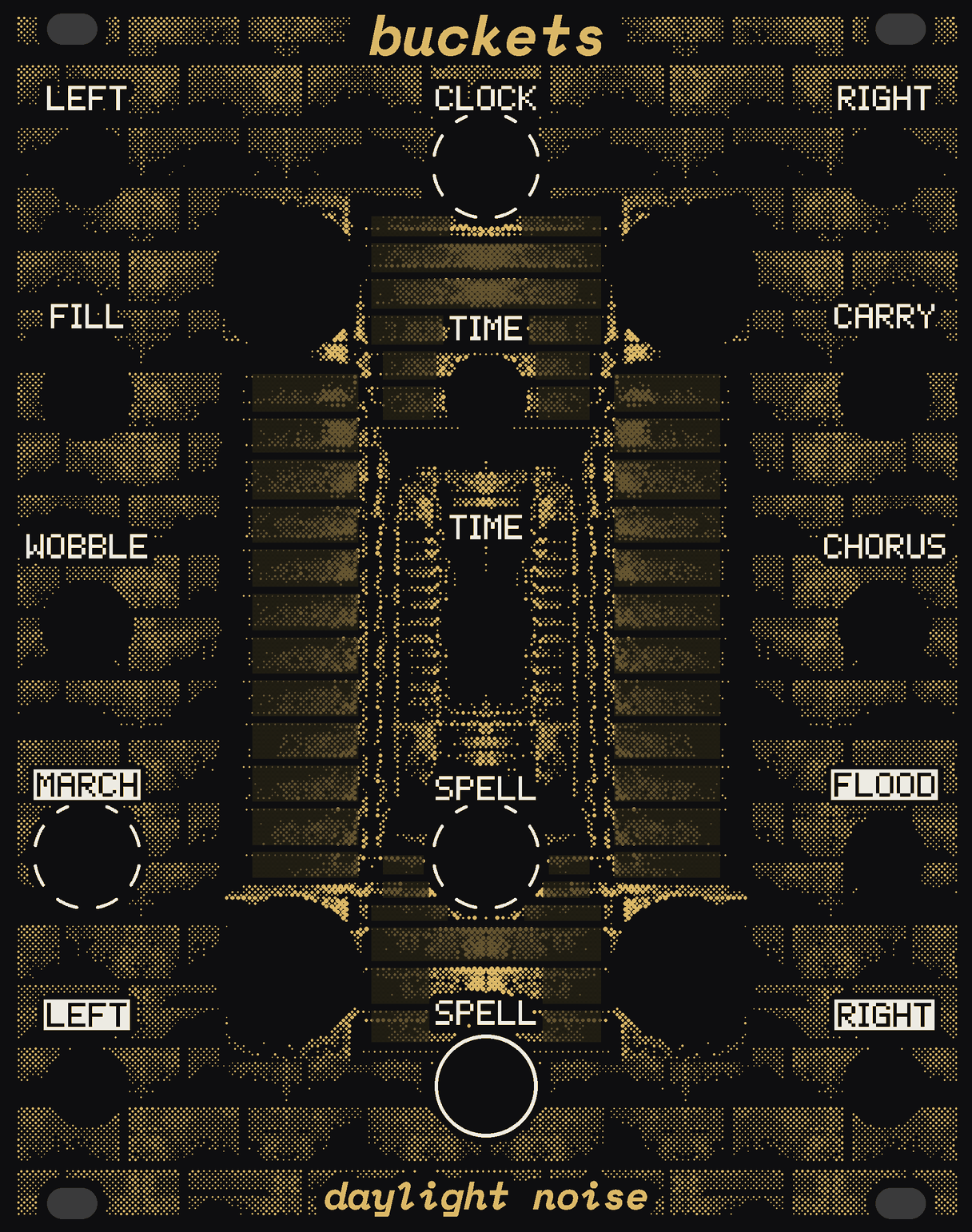
The BUCKETS panel: black, a square stone stair seen from above in gold dots, a wall round it, a chip on each of its four landings and every tread a window. TIME, the big knob, in the well in the middle, its jack above it and SPELL's below, CLOCK at the top and the SPELL button at the foot. FILL and WOBBLE down the left, CARRY and CHORUS down the right, MARCH and FLOOD under them, LEFT and RIGHT in at the top corners and out at the bottom corners. buckets at the top, daylight noise at the bottom.

The chips: drag one off its landing. The socket holds on, then lets go; the line closes up over the hole and its flight goes dark. Drag it home to put it back. On a keyboard, tab to it and use the arrow keys; a tap does it too. Turn a knob: drag it or tap either side of it, roll the wheel over it or use the arrow keys; a double click puts it back. SPELL is a button. The patches step on by themselves until you touch anything.

Plucks, a chord and drums in F minor at 100 BPM into BUCKETS. Listen plays the patch from its top.

example patches

The sound path in BUCKETS is analogue, with no converters in it, so what you're hearing is a model of the circuit running in your browser: each chip a real line of buckets moved on by its own clock. The clock, the taps and the lights are the module's own. The rack round it is a stand-in.

It carries

A bucket-brigade chip is thousands of capacitors in a row. Each tick of a clock, every one hands its charge to the next. Slow the clock and the sound takes longer and loses its top: there's no memory here, only a queue. Four chips stand in line, two short and two long, and what comes off the last goes back to the first.

It splits, and it floods

You can only reach into a line of buckets where one chip ends and the next begins, so there are four places to listen. Up to noon you hear the last. Past noon the others open, one at a time up the line, and each chip starts keeping a share of what it's handed, so every copy splits in two. They slide apart in time as they go. The room fills, and the mix tips over from what you're playing to what's still going round.

You can pull a chip out

The four chips on the landings aren't behind the panel: they're plugged into it, and each one is a stretch of the line. Pull one and whatever was in it is gone, and the line closes up over the hole: shorter, brighter, with a different rhythm of taps. The long ones are twice the short ones, so each hole you leave makes a different pattern. Put it back and the sound takes the long way round again. Pull all four and there's nothing left to carry anything.

Three more lines

Behind the panel are three short chips that have nothing to do with TIME. They run on everything, the echoes included, each wobbling a third of a turn behind the last.

What comes out

Specs

Format

Width
20 HP
Controls
a big knob, 4 knobs, a lit button, 4 chips you can pull

Inputs

LEFT, RIGHT
audio, ±5 V; RIGHT follows LEFT
TIME
CV, a volt an octave of clock
CLOCK
clock
SPELL
gate

Outputs

LEFT, RIGHT
audio, ±5 V
FLOOD
CV, 0 to 8 V
MARCH
gate, 5 V