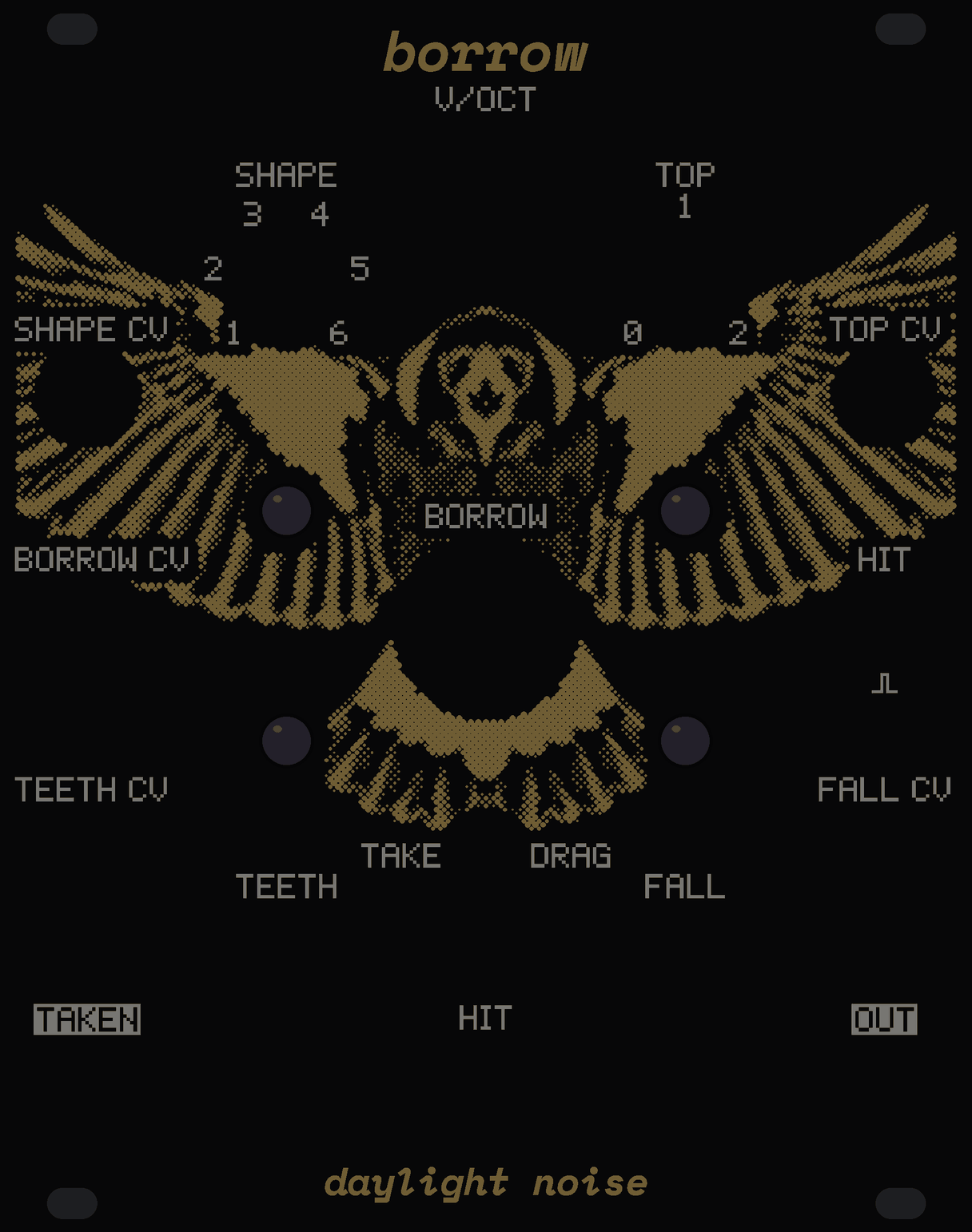
20 HP · chip voice
A chord on three square waves, and drums that steal from it. The sound chip in a mid-80s games console could only tune its noise by borrowing its third voice's pitch. BORROW makes that the instrument: every hit takes the chord's top note, lands on it four octaves down, and gives it back when it's done.
Turn a knob: drag it, roll the wheel over it or use the arrow keys; a double click puts it back. The switch flips with a click, and HIT's button fires a hit.
example patches
BORROW is a concept. Nothing has been made: there's no board and no firmware. The sound is a sketch of the idea, written for this page, and the lights are lit by it.
The chip has three square-wave voices and one noise channel. The noise runs at one of three fixed rates, or at the third voice's pitch, and that's the only way to tune it. BORROW always tunes it, so every hit borrows the third voice.
The noise has two settings. White is a 16-bit shift register fed back from two of its bits. Periodic is a single bit going round it: at the third voice's pitch, that's a pulse a sixteenth wide, four octaves under the voice, a buzz with a note in it. TEETH says how much of a hit is hiss before it buzzes.
FALL is where the hit starts: up to five octaves above the stolen note (never above 16 kHz), falling onto it, faster for a short hit. Wherever it starts, the buzz lands on the chord's top note, four octaves down, so the drums are always in the chord's key. TEETH CV and FALL CV add a tenth of their knobs a volt and are read at each hit, so a sequencer can make every step a different drum.
TAKE is what the era's music did when a sound effect needed a channel: the borrowed voice goes quiet and the hit has its pitch to itself. DRAG leaves the third voice sounding while the hit sweeps its divider, so every hit pulls the note down from FALL's height onto itself. It's the chip's coupling, left where you can hear it.
TAKEN is a gate out, high while the third voice is borrowed. Use it to duck something else in the case in time with the hits.
V/OCT sets the root, 1 V an octave, with 0 V at middle C. SHAPE picks the other two notes: octaves, a fifth, minor, major, a minor seventh, or a flat second over a fifth. The third voice is always the top note. TOP moves it up one or two octaves, and every hit goes up with it. SHAPE CV steps a shape a volt, TOP CV an octave a volt.
The chip's dividers are ten bits on a 3.58 MHz clock. Nothing goes under 109 Hz, about two octaves under concert A, so a lower note goes up an octave until the chip can play it. The higher a note, the coarser the dividers; the readout beside the panel shows how far out of tune each voice lands, in cents. The only bass the chord gets is the hit.
OUT is the chip, mono: the three voices and the noise, through a coupling capacitor like the console's.
Twenty HP, every part on the line's staggered grid and mirrored about the middle. The art is a magpie swooping at you in a flash at night, wings spread and beak open, in gold dots. Its head sits in the one empty place on the middle line. Four violet lights sit round BORROW: voices 1 and 2 above it, voice 3 and the noise below, so on a hit the light passes from voice 3 across to the noise.
BORROW is a concept, a drawing of the panel and this page. Nothing has been made.