bookends

out of step and back

20 HP

Your sound as twins, side by side. The second slips out of step a step at a time, stays at each new place, and a whole lap later they're together again. And again. Where they meet, a ghost sings.

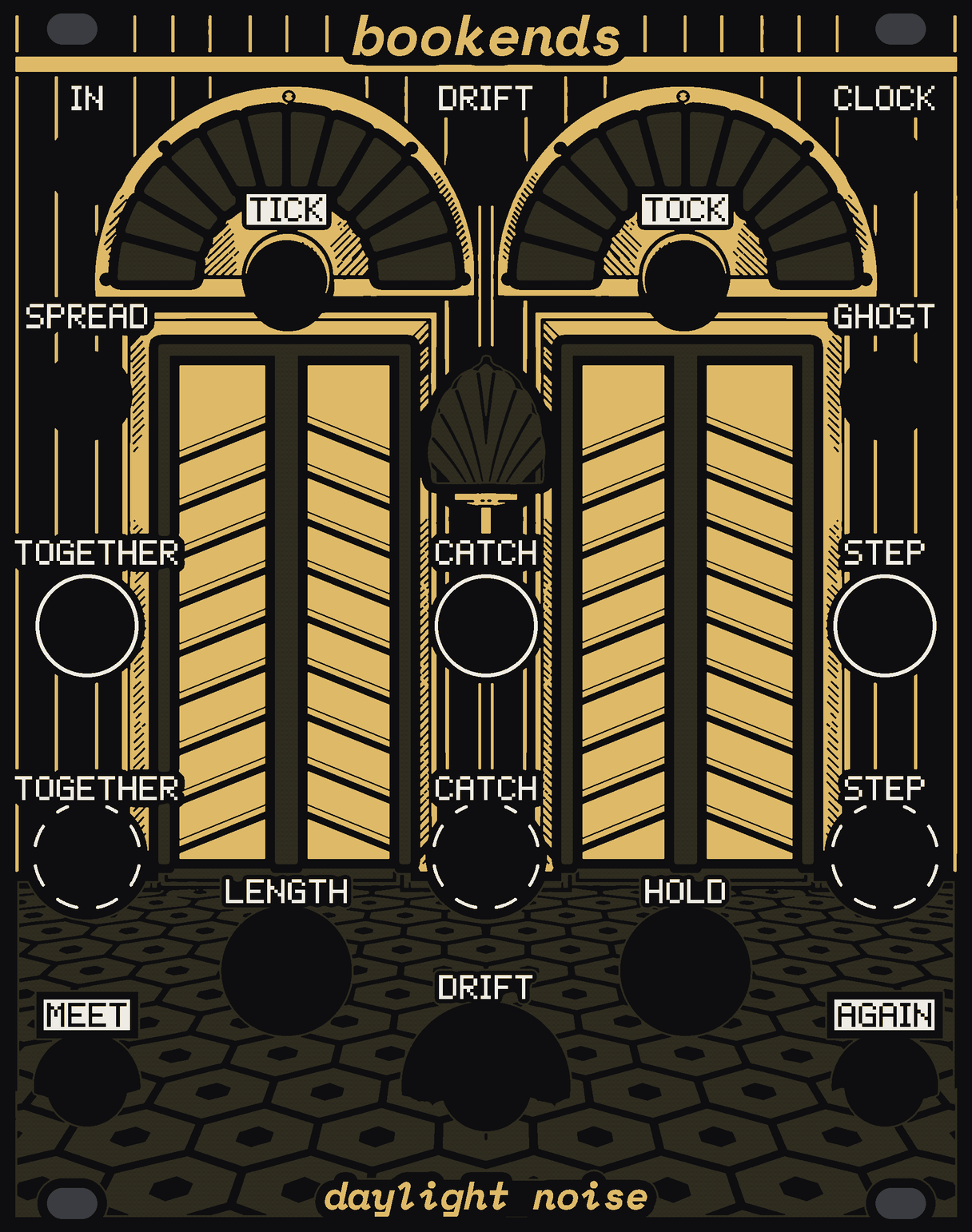
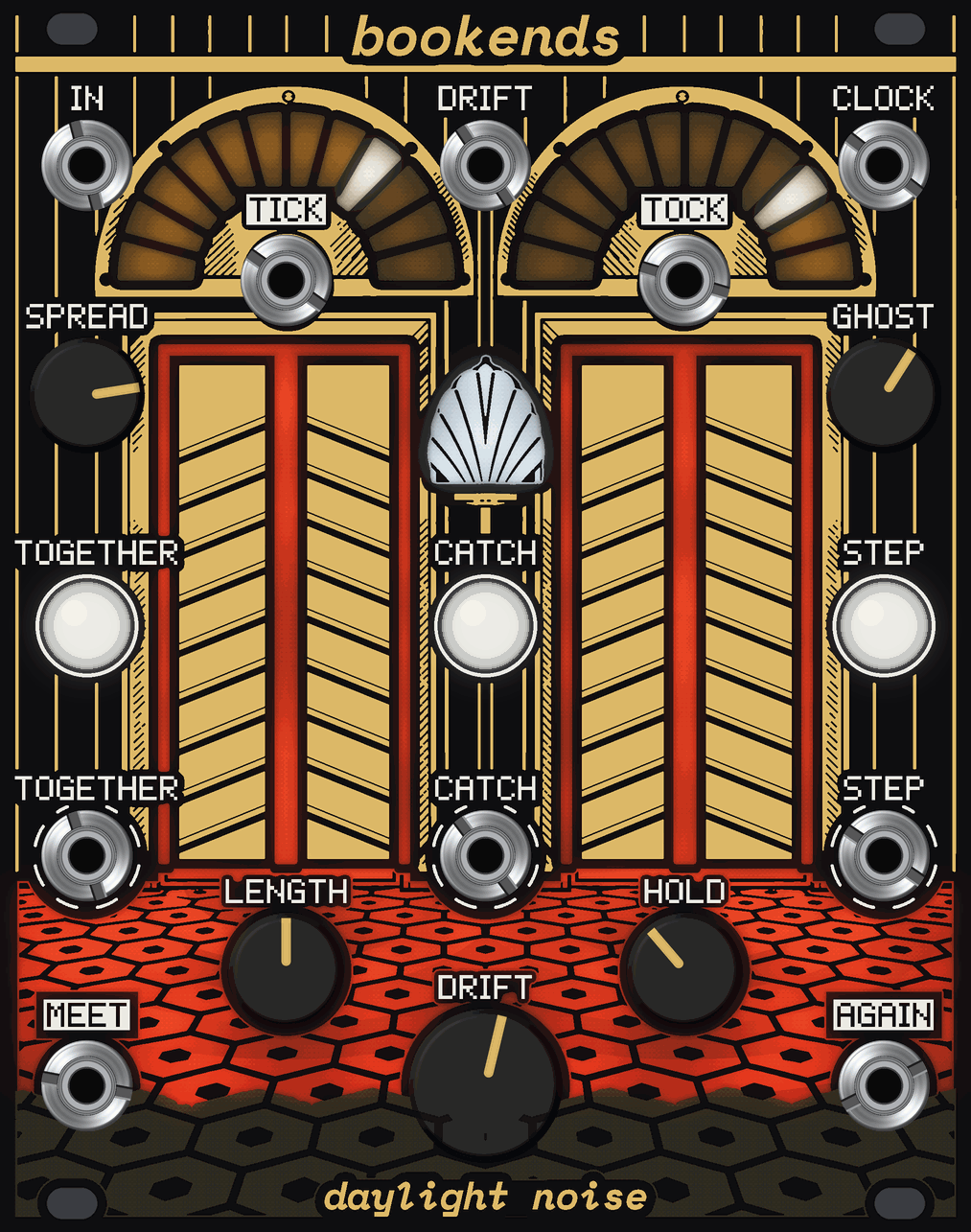
The BOOKENDS panel, black and gold: two brass lift doors at the end of a corridor, a half-moon dial of lit spokes over each with an output at its pivot, TICK on the left and TOCK on the right (white plates with the words cut out), a clamshell lamp between them and a hexagon carpet lit red in front. DRIFT, the big knob, at the foot; CATCH, STEP and TOGETHER across the middle; the other knobs and jacks round the edges.

Turn a knob: drag it or tap either side of it, roll the wheel over it or use the arrow keys; a double click puts it back. STEP slips the second twin a step, TOGETHER brings it back, CATCH keeps the last lap.

The twins, the walk and the ghost, in your browser.

Pick a sound file, or drop one here: a loop works best. Its first minute plays through the module with every knob yours. It's opened in your browser and never leaves your computer.

example patches

Everything BOOKENDS does here is the module's own engine in your browser, and it hears only what comes into its jacks. The dance band, the beeps and the celesta are a stand-in rack, unless you give it your own. Its own little tune is new every visit.
Side by side

Put a loop into IN: a riff, a drum loop, a bass line. It comes out twice: the first twin on TICK, exactly as it came in, the second on TOCK. At first they play together. Then the second slips back a step, stays a while, slips another, until it's a whole lap behind, which for a loop is the same as together. And it starts over, as long as you leave it running.

Nothing in IN? It plays its own twelve-note tune on its own small bell, a new one every time it's switched on: plug one cable into TICK and it plays a whole piece.

The places between

DRIFT and HOLD

The lap, and the clock

Where they meet

CATCH

What it can't do

Inside

The BOOKENDS panel playing, the doors' seams and the carpet lit red.

Drag it or use the arrow keys to turn it; click it to take it apart.

Specs

Format

Width
20 HP
Depth
20.6 mm behind the panel
+12 V
about 126 mA dark, 202 mA playing, 314 mA at the most, the lights held to their cap (estimated)
−12 V
about 5 mA (estimated)
+5 V
not used
Controls
five knobs (DRIFT, HOLD, LENGTH, SPREAD, GHOST), three lit buttons (CATCH, STEP, TOGETHER)
Light
124 RGB LEDs under the dials, the doors, the lamp and the carpet
Replaces
a clocked delay, a looper's hold and a second sequencer to play against the first

Inputs

IN
audio to ±10 V: what the twins play (nothing: its own little tune)
CLOCK
gate: each rising edge is a step (nothing: 120 BPM in sixteenths)
DRIFT
CV, added to the knob: 1 V a tenth of its turn
CATCH
gate: the last lap kept while it's high
STEP
gate: each rising edge slips the second twin a step
TOGETHER
gate: each rising edge brings them back in step

Outputs

TICK
the left out, audio to 10 V: the first twin's side of SPREAD, and the ghost (nothing in TOCK: all of it, so one cable goes here)
TOCK
the right out, audio to 10 V: the second twin's side of SPREAD, and the ghost
MEET
gate: on each step where the twins meet
AGAIN
gate: when they're together again after a whole lap of places

Engine

Brain
RP2350 at 240 MHz, 46.875 kHz: this page's engine, every step it takes the same
Memory
44.7 s of sound: the longest lap, 16 steps of 2 s, and room to spare