blowhole

the waves play it

20 HP

A voice with no notes to play. Seven stone pipes, tuned to a chord, open in a flight of steps by the sea. Every wave that climbs the steps makes the pipes it passes breathe, one after another up the chord.

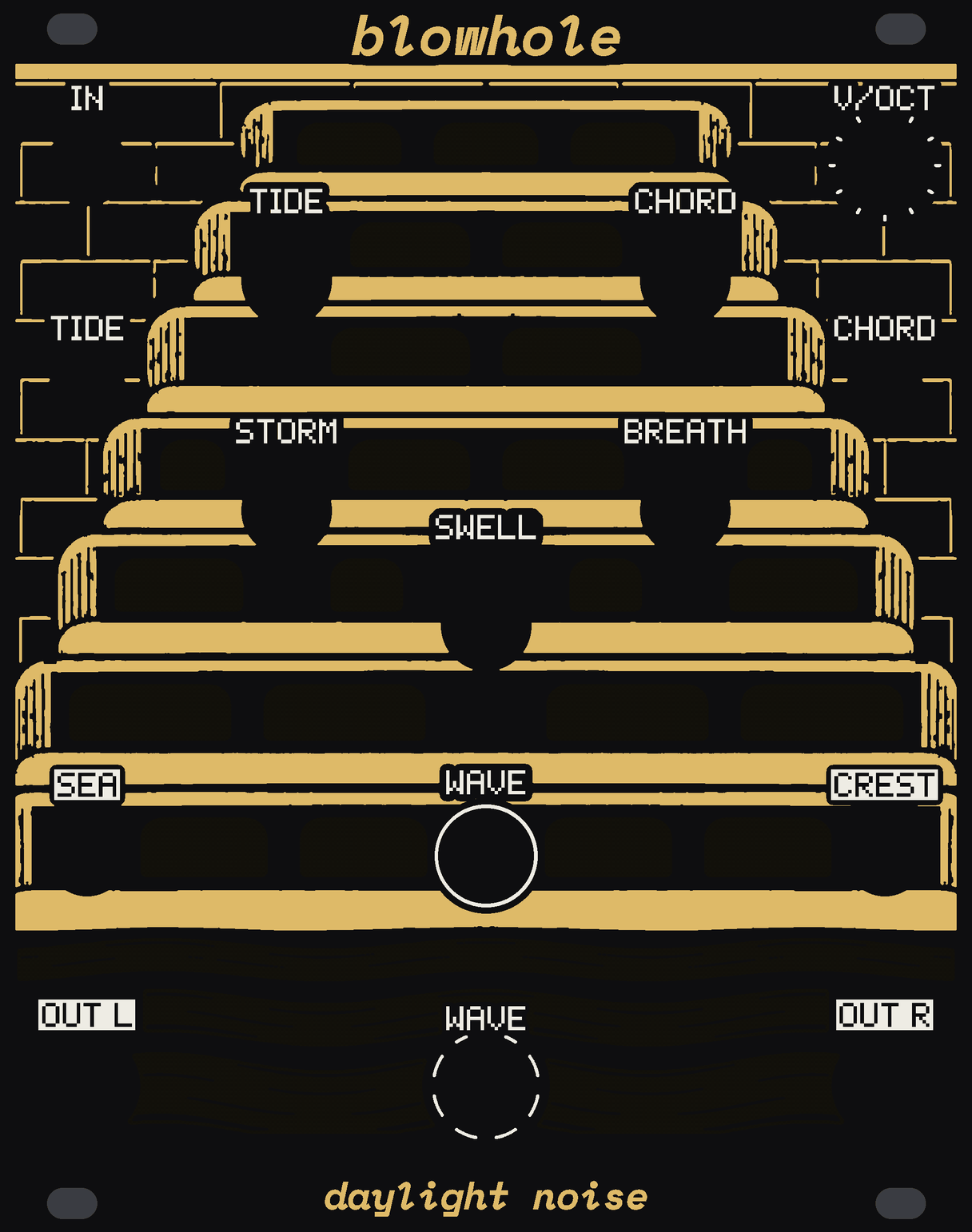
The BLOWHOLE panel, black and gold: a bold drawing in gold ink of a flight of seven stone steps rising out of the sea at night, seen from the water. The steps narrow toward the top, each one's tread a band of flat gold with an inked front edge and its rounded ends hatched; behind them on both sides the quay walls are black blocks outlined in thin gold lines. Every step's upright face is in black shadow with a row of arched pipe mouths in it, each mouth a window, wider on the steps near the sea. At the foot three long wavy bands of sea are windows too, with black ripple strokes across them. SWELL, the big knob, sits in the middle of the flight; the other knobs, the WAVE button and the jacks stand on the steps and the quay walls.

Turn a knob: drag it or tap either side of it, roll the wheel over it or use the arrow keys; a double click puts it back. Press WAVE to send a big wave up the steps. The patches step on by themselves until you touch anything.

Synthesised here, as the module would make it: the sea, every pipe's breath and tone, the stone under the steps and the waterfront, with a stand-in rack round them.

example patches

Everything BLOWHOLE does here is its engine as designed, in your browser: the sea, the tide, the pipes, the light. The bell, the stones, the guitar, the drum and the pulse round it are a stand-in rack.

The waves play it

Seven pipes run under seven stone steps, and each one opens in a step's face. The bottom step's pipe sings the lowest note, the top step's the highest, and together they're a chord. Nobody plays them. The sea does.

Each wave comes in from the far band of the sea at the foot of the panel, reaches the steps and climbs them. As the water rises past a pipe it pushes the air out of it, so that pipe breathes its note; the next one up breathes as the water reaches it, and so on as high as the wave goes. As the wave falls back the pipes draw breath again, more softly, on the way down. A small wave sighs on a pipe or two at the bottom; a big one runs up the chord to the top step.

SWELL is the size of the waves. Fully left the sea is flat and nothing sounds. At noon a wave comes every eight seconds or so and crosses four pipes. Fully right it's a big slow swell that reaches the top step. The waves are never quite the same twice, and every so often a set of bigger ones rolls in.

On the face you can watch it happen: the mouths under the water glow blue, the row the water is passing blazes gold-white with the air rushing through it, and the rows above it sit at a low ember. The sea's three bands brighten as each wave comes in, before it climbs.

The tide and the storm

The chord in the stone

Your sound is the sea

In a rack

Specs

Format

Width
20 HP
Controls
a big knob (SWELL), four knobs (TIDE, CHORD, STORM, BREATH), a lit button (WAVE)
Lights
27 windows: 23 pipe mouths in the steps and the sea's bands, on 68 colour LEDs
Replaces
a chord voice, a slow random source, and an envelope follower
Parts
a demo for now: the line's knobs, jacks and button, no board yet

Inputs

IN
audio: its loudness is the sea
V/OCT
1 V an octave: the chord's root, D unpatched
TIDE
CV: adds to TIDE, 5 V a full turn
CHORD
CV: adds to CHORD, 5 V a full turn
WAVE
gate: a wave now; patched, the sea waits for it

Outputs

OUT L
audio: the left mouths
OUT R
audio: the right mouths
SEA
CV: the water's height, 0 to 8 V
CREST
gate, 10 V for 10 ms, at the top of every wave