blazin’

a drive with a temperature

12 HP

Playing heats it and silence cools it. It isn't a drive you set but a fire you feed, and over a song it lives a fire's whole life by itself: it warms, smokes, catches, burns out, cools and lights again.

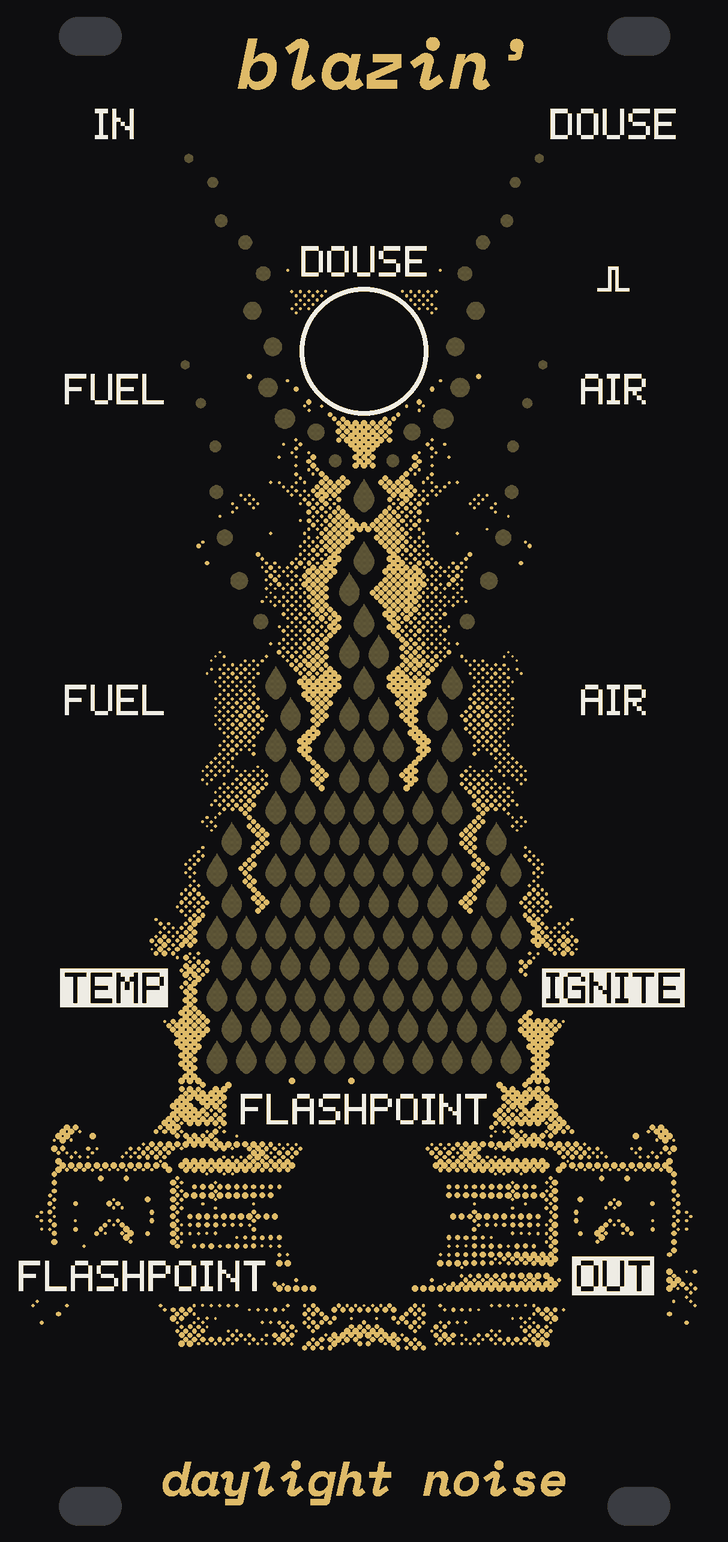
The BLAZIN’ panel: black, with a burning car in gold dots at its foot and its fire rising up the middle, 107 little teardrop windows of bare circuit board, and two wisps of round smoke windows curling up either side of the DOUSE button under the name. IN and DOUSE's jack at the top corners, the FUEL and AIR knobs and their jacks down the sides, TEMP and IGNITE beside the fire's foot, FLASHPOINT's knob under the fire, FLASHPOINT's jack and OUT at the bottom. blazin’ at the top, daylight noise at the bottom.

Turn a knob: drag it, roll the wheel over it or use the arrow keys; a double click puts it back. DOUSE is a button: press it to throw a bucket of water on the fire. The patches step on by themselves until you touch anything.

What you hear is the rack through BLAZIN’: the drums and the bass into IN, OUT in the middle, a pad and an arp beside it. All of it is made in the page as you listen.

example patches

The heat, the lights and the sound here are the module's engine as it's designed, running in your browser: every catch, every burnout, every hiss of steam. The drums, the bass, the pad and the arp are a stand-in for the rest of a rack.

Feeding it

What you play is the fuel: the louder, the hotter, the loud end counting most. Alight, the fire feeds on itself and climbs, so a long loud stretch burns it out.

Air

The air cools the fire and fans it alike, so AIR sets how fast the fire lives, not how hot it gets.

Putting it out

The four stages

Each louder and harsher than the last, all made from the sound itself, and each a step you hear, not one smooth knob.

What comes out