bearing

it points at what it wants

20 HP

A brass needle behind glass does the mixing. Coils pull it by your levels, the Earth pulls it too, and wherever it actually points is the mix: it swings at a snare, overshoots, hunts and settles with its own weight. Leave it alone and it drifts round to wherever the Earth's field crosses your case.

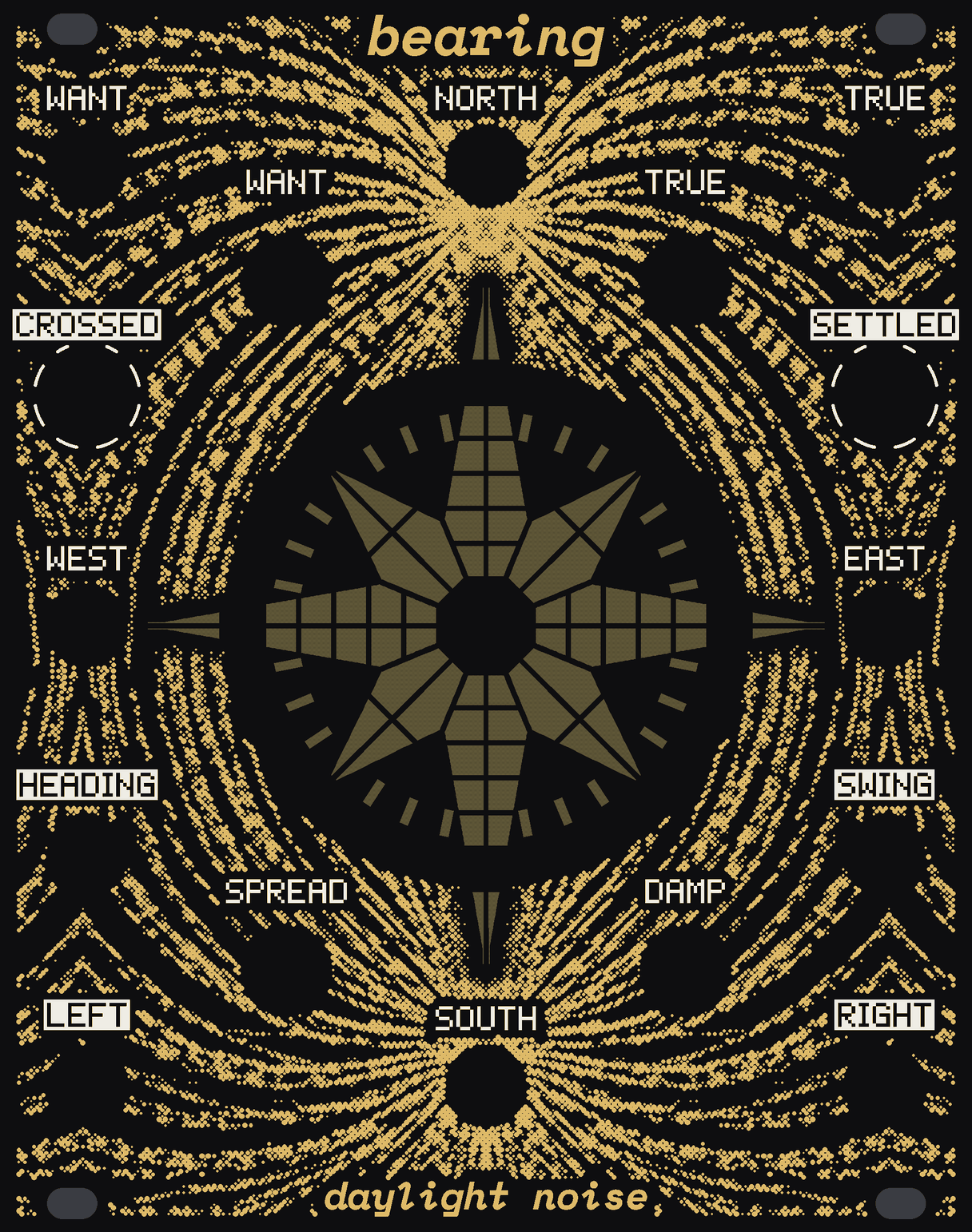
The BEARING panel: black, gold dots of iron filings curving from a pole at the top jack to a pole at the bottom jack and bulging out round the middle. In the middle, under a round glass in a black frame, a brass needle over a compass rose in bare circuit board, a long point towards each of the four jacks NORTH, EAST, SOUTH and WEST.

Turn a knob: drag it or tap either side of it, roll the wheel over it or use the arrow keys; a double click puts it back. The needle is yours: drag it round, flick it and let go, or tab to it and use the arrow keys; it swings back. The patches step on by themselves until you touch anything.

A dark loop in A minor at 118 BPM, its parts in NORTH, EAST, SOUTH and WEST. Listen plays the patch from its top.

the case

example patches

Everything BEARING does here is its engine as designed, running in your browser, the needle a model of the real one. The loop is a stand-in rack.

The needle

Four inputs, four directions. Each one is heard when the needle points its way, and pulls the needle its way: the louder it is, the harder its coil pulls. So a snare on EAST yanks the mix east and it swings back through the others. Nobody programmed the swing: it's a real weight on a real shaft. Two steady channels make it sit between them, trembling.

What holds it

The mix

What comes out

Specs

Format

Width
20 HP
Controls
2 big knobs, 2 knobs, a needle

Inputs

Four directions
NORTH, EAST, SOUTH, WEST: audio or CV, ±5 V
WANT, TRUE
CV, added to their knobs, 5 V the whole way

Outputs

LEFT, RIGHT
audio, ±5 V
HEADING
CV, ±5 V
SWING
CV, 0 to 8 V
CROSSED
trigger, 5 V, 10 ms
SETTLED
gate, 5 V