barrels

something's down there

20 HP

Audio in, three CVs out. Whatever you patch in is the thing under the water: you never hear it here, you see it by three barrels on lines harpooned into it, each one's height a voltage that rides it with a body of its own. When it dives it takes all three under, and they burst back up.

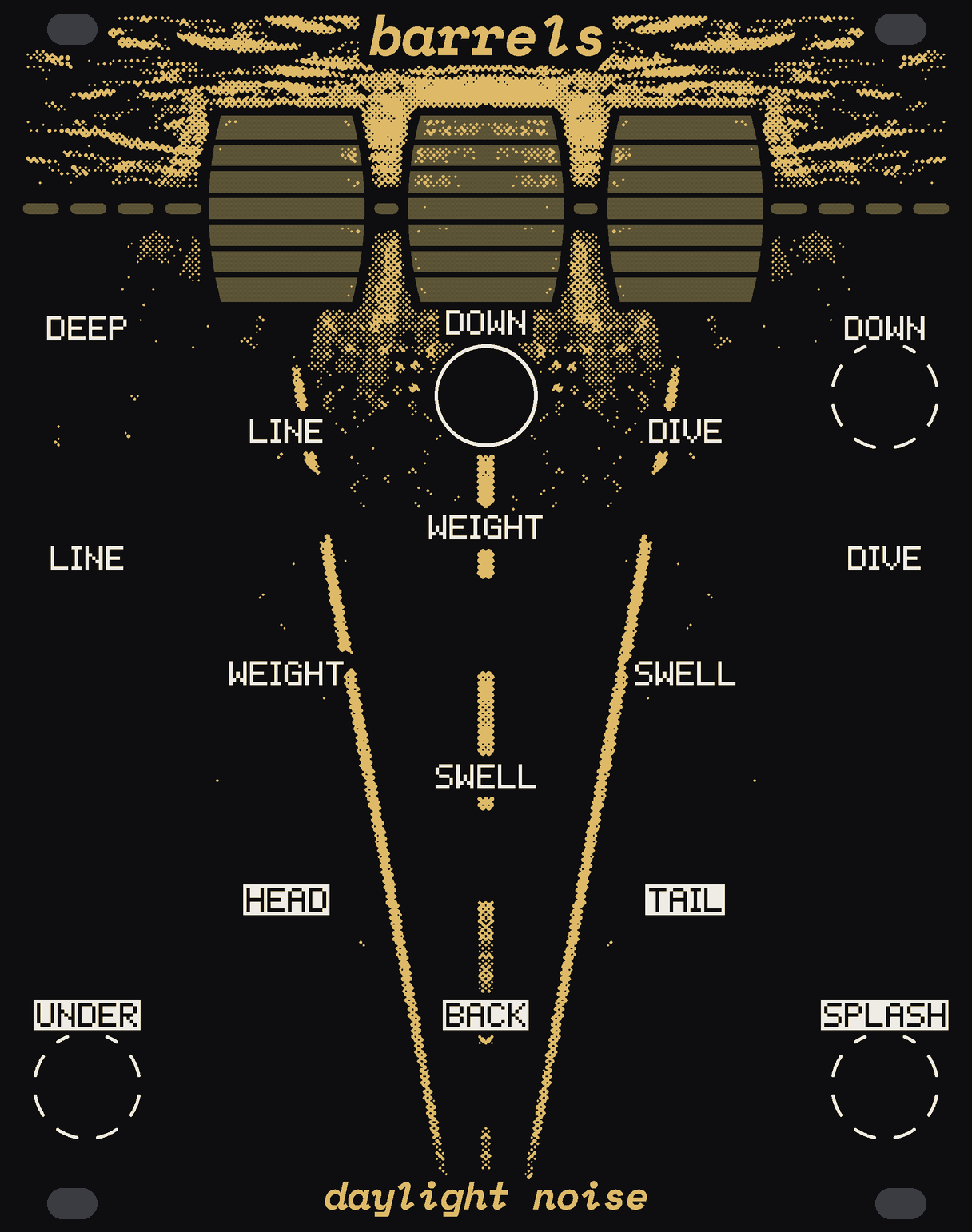
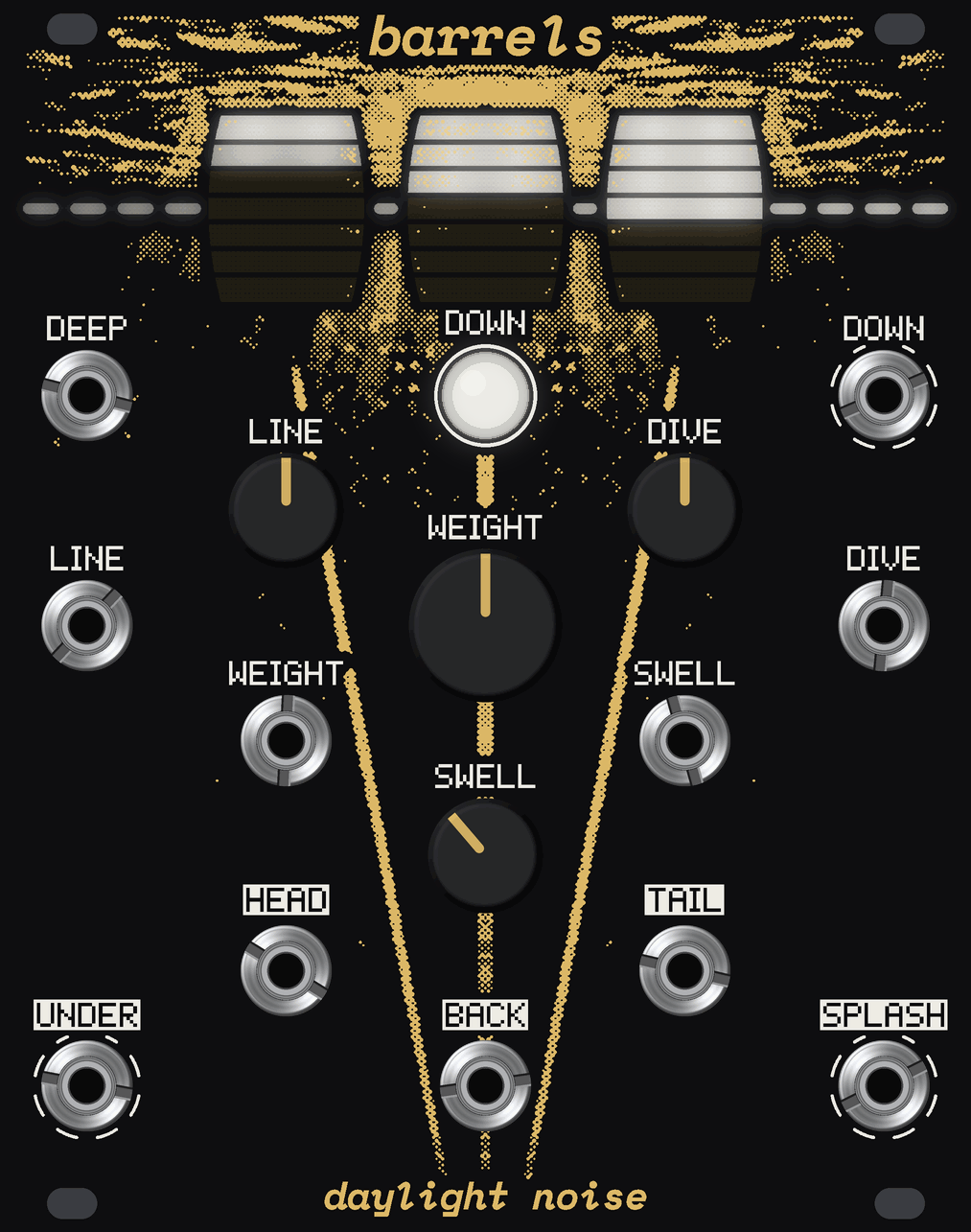
The BARRELS panel: black, gold dots of the sea seen from under the water, the lit surface overhead round the name. Three barrels across the top are windows of bare circuit board, each cut by its hoops into seven bands, on a row of short lit dashes for the waterline, and from each a rope runs down and in to meet the others at the foot. DEEP and DOWN's jack under the barrels with the DOWN button between them, LINE and DIVE either side of the big WEIGHT, the CV jacks, SWELL under WEIGHT, HEAD, BACK and TAIL at the foot of the barrels' columns, UNDER and SPLASH in the corners. barrels at the top, daylight noise at the bottom.

Turn a knob: drag it or tap either side of it, roll the wheel over it or use the arrow keys; a double click puts it back. DOWN is a button: hold it down and the thing takes them under. The patches step on by themselves until you touch anything.

A rack round BARRELS: a drum machine and a bass into DEEP; the barrels move the bass's filter, a pad's swell, the hats' pan and how far the whole mix sinks. Listen plays the patch from its top.

example patches

The barrels, the sea, the pull and every out and light here are BARRELS's engine, the module's own code, running in your browser. The drums, the bass and the rest are a stand-in rack.
Something's down there

Three barrels are on lines into the thing, each listening its own way, and each one floats: buoyancy, weight, drag, a line that pulls only when it's taut, and a sea under it. So they don't follow the sound, they ride it.

The barrels and the sea

Going under

Three barrels can hold it up, and an ordinary pull can't keep one under. When it dives, they all go.

What comes out

Inside

One board sits 10 mm behind the panel with everything on its front: the jacks, the knobs, DOWN's button, the 52 LEDs and the whole circuit, the USB-C in a notch in its left edge. Each band of a barrel has two white LEDs in its own cell of a black printed baffle, so a barrel lights band by band from the top; each dash of the waterline has one. An RP2350 listens to DEEP and runs the sea and the barrels on one core.

The BARRELS panel riding a groove: the head's barrel ducked, the cask lower, the keg riding high, the waterline lit, its knobs and button on.

Drag it or use the arrow keys to turn it; click it to take it apart.

Specs

Format

Width
20 HP
Depth
20.8 mm behind the panel
+12 V
about 45 mA dark, 170 mA in play, 200 mA with light barrels, 245 mA at the most (estimated)
−12 V
about 5 mA (estimated)
+5 V
not used
Controls
a big knob, 3 knobs, a lit button

I/O

DEEP
audio in, 24-bit; ±9 V reaches the converter unclipped; never passed through
DOWN
gate, held while high, past about 0.9 V; safe to ±12 V
CVs in
WEIGHT, LINE, SWELL, DIVE: added to the knobs, 5 V half the travel; −5 to +5 V, safe to ±12 V
CVs out
HEAD, BACK, TAIL: 0 to 8 V, 16-bit, each barrel's height; 5 V afloat on a calm sea
UNDER
gate, 0/5 V, while all three are under
SPLASH
trigger, 0/5 V, 10 ms, as each one surfaces

Engine

Brain
RP2350, one core, at 46.875 kHz, 32-bit float; the barrels 4,000 steps a second
Light
31 windows, 52 white LEDs, 100 frames a second
Power cycle
the barrels wake at rest on a calm sea; only the calibration is kept