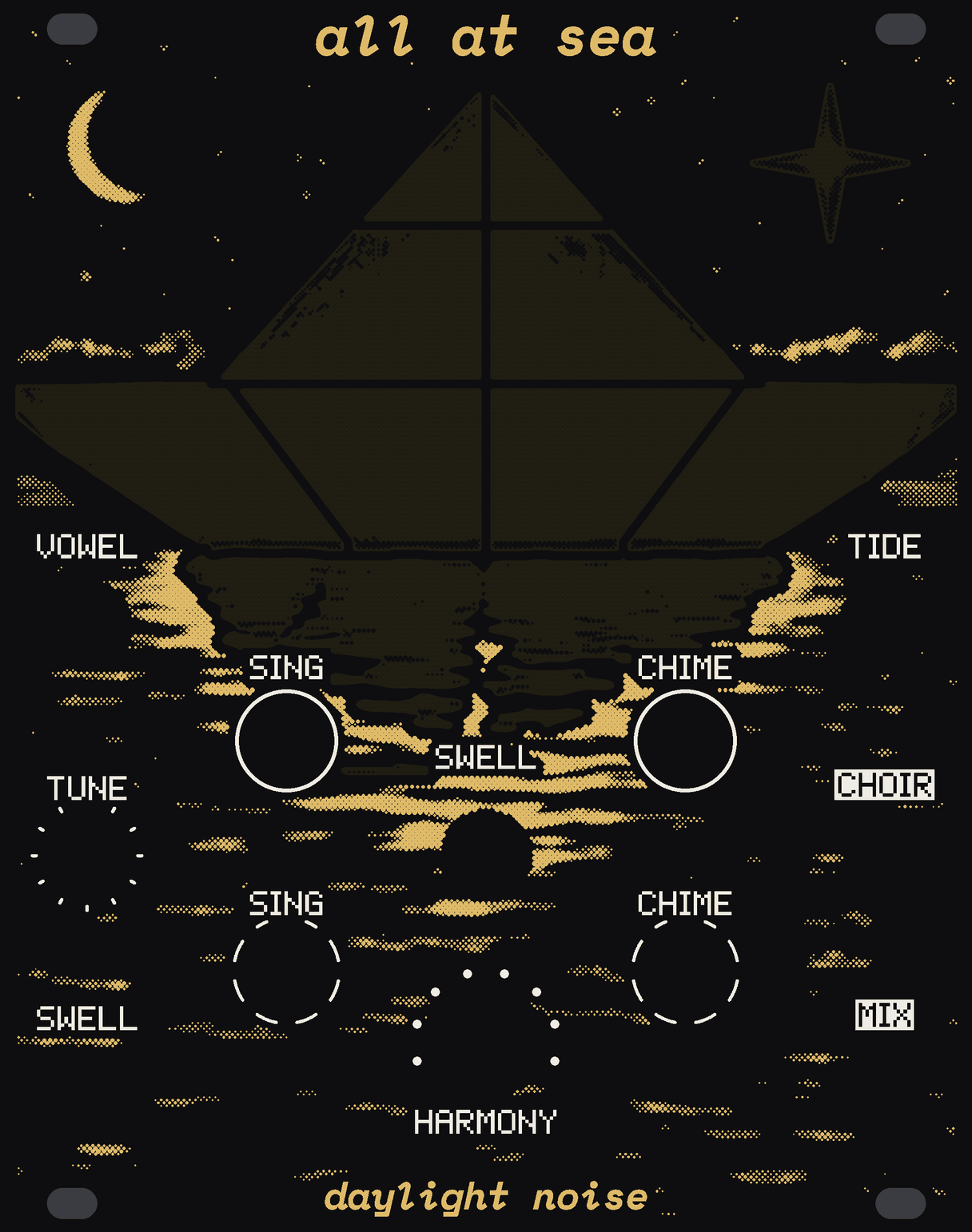
a choir in a paper boat
20 HP
A young children's choir you play. Hold SING and they sing your note; turn SWELL and more of them come in, from one child alone to the whole choir; HARMONY picks the chord they make. A toy piano and a vibraphone climb the chord, and the sea washes underneath.
Turn a knob: drag it or tap either side of it, roll the wheel over it or use the arrow keys; a double click puts it back. SWELL, the big one in the middle, is how many children sing: one alone fully left, all of them fully right. HARMONY clicks through its eight chords. Hold SING down (or a key) and the choir sings; tap CHIME for a bell. The patches step on by themselves until you touch anything.
example patches
Everything ALL AT SEA does here is its engine as designed, running in your browser: who sings, on what notes, how they breathe in and slide into each note, the bells and the sea. The voices are synthesised, made from scratch the way a module would make them; they are never recordings or copies of real children. The ballad around them is a stand-in rack.
A choir of children has a sound nothing else has: a little breathy, never quite together, a few of them a touch sharp and a few a touch flat, and when they all come in at once it lifts a whole song. It's hard to get from a synth, because a synth pad is one sound made wide, and a choir is lots of small voices that each do their own thing.
ALL AT SEA is that choir, twenty children in eight parts, from the lowest voices to the highest, and you play it like any voice in your rack. Hold SING and they sing your note, wordless, on ooh or aah. Turn SWELL and more of them come in, the low voices first, the way a choir lifts into a chorus. HARMONY picks the chord they make around your note, so one note at TUNE is already a chord.
The children are synthesised, every one of them: the module makes each voice from scratch. Nothing here was recorded from a real child, and no real child's voice is copied.