alert

20 HP · sequencer

A sequencer that turns a loop into a scene with an arc. It walks a patrol and listens. Make enough noise and "!" fires on the next bar: the loop drops into double time, breaks down into fragments, builds back nervously, and goes back on patrol. Each part of the arc has its own gate, so it can re-arrange the rest of the rack.

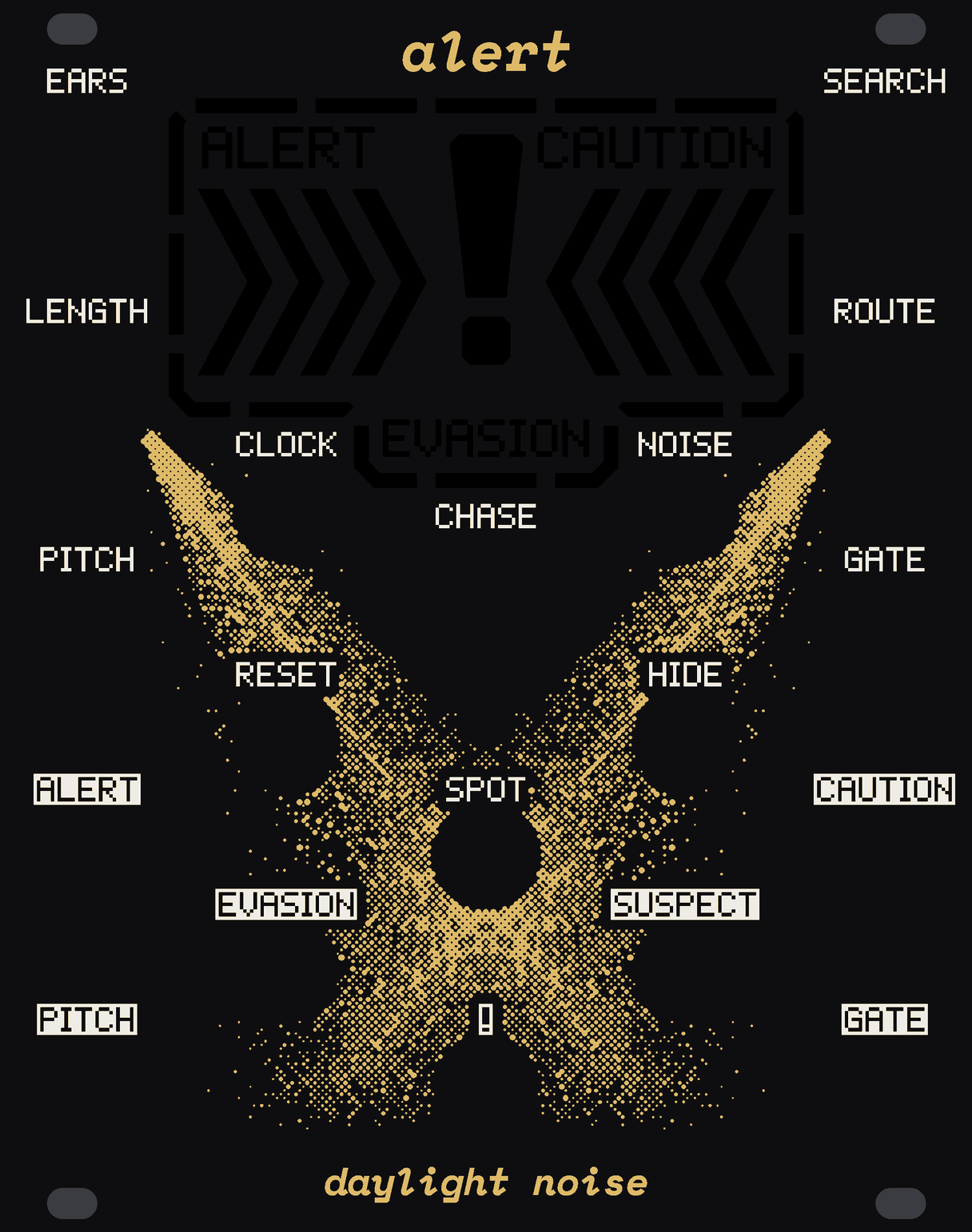
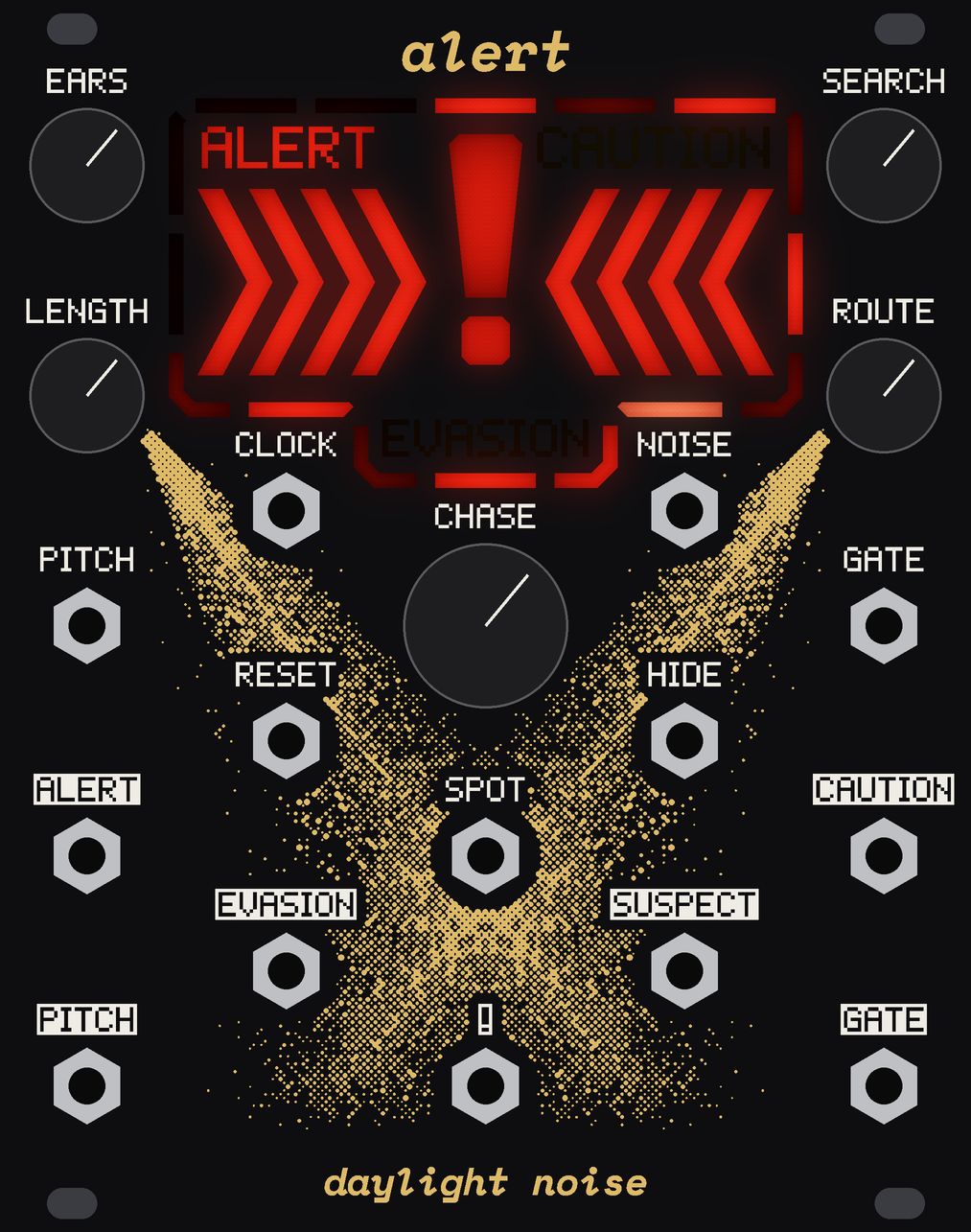
The ALERT panel: black, with a screen of bare glass under the name. Sixteen dashes run round the screen's edge, the patrol's steps; inside them a big exclamation mark, four chevrons either side pointing in at it, and the words ALERT and CAUTION in solid pixel letters at the top corners, EVASION below the exclamation mark. Under the screen, two searchlight beams in gold dots, full of fog and rain, cross on the SPOT jack. White labels: EARS, SEARCH, LENGTH and ROUTE round the screen, CHASE on the big knob, the CLOCK, NOISE, PITCH, GATE, RESET, HIDE and SPOT jacks, and the outs ALERT, EVASION, CAUTION, SUSPECT, PITCH, GATE and !. alert at the top, daylight noise at the bottom.

Turn a knob: drag it, roll the wheel over it or use the arrow keys; a double click puts it back.

Nothing plays until you press it. Each patch starts again from its first bar.

example patches

The module's own engine, running in your browser: the firmware's rules, ported from its C and checked against it bit for bit, lighting the screen cell by cell as the LEDs behind it will be. The rack round it (drums, a lead or a bass, a pad, a riser and an impact) is a stand-in, all synthesized here.
Patrol

ALERT takes a step for each pulse at CLOCK and counts sixteen steps to the bar, from the first pulse or from RESET. On patrol it walks a loop of LENGTH steps, 1 to 16, round the edge of the screen in green, clockwise from the top. Each note lights its step as it plays.

Listening

Anything at NOISE can give you away: a drum, a gate, audio. Each hit, a sharp rise past 1 V, adds to suspicion, louder hits more, up to 5 V. The chevrons either side of the "!" close in from the outside as it rises.

When the meter fills, the dot of the "!" blinks: it has heard you and is waiting for the bar. On the next bar line "!" fires, unless HIDE is high there and it only heard noise. The "!" out is a trigger, always on a downbeat.

The arc

After "!" the loop plays out three parts, each a whole number of bars, and goes back on patrol. SEARCH sets how long they take, in six steps: 2 + 1 + 1, 2 + 2 + 2, 4 + 2 + 2, 4 + 4 + 4, 8 + 4 + 4 and 16 + 8 + 8 bars.

Outs

The panel

The screen under the name is the panel itself, lit from behind: 29 windows of bare fibreglass, no copper or mask on either side, each over its own cell of a black printed baffle with its own RGB LEDs, 44 in all. The patrol's sixteen steps are dashes round the screen's edge. Inside them a "!" 24 mm tall, four chevrons each side for the meter, and the arc in solid pixel letters: ALERT and CAUTION at the top corners, EVASION at the foot. The steps glow green on patrol, red for "!" and ALERT, amber for EVASION and yellow for CAUTION.

Below it, in gold dots, two searchlights hang under the screen's corners as on a watchtower, their beams full of fog and rain, crossing on SPOT.

Inside

The ALERT panel, its screen lit at ALERT, with its knobs on.

Drag to look around. Lift the panel to see the baffle's cells, lit from the LEDs on the board. Nothing has been made yet.

One four-layer board sits 10 mm behind the panel, with the jacks, the knobs and the 44 LEDs on its front and everything else on its back. An RP2350 runs the engine 16,000 times a second and hears NOISE at 48 kHz, so a clock pulse reaches PITCH and GATE in well under a millisecond. PITCH and GATE come from a 16-bit DAC, together; SUSPECT from a filtered PWM. Each unit's PITCH can be calibrated over USB with a meter and two readings. The DAC is only linear from about −1.92 to +8.12 V at PITCH, so the lowest note or two may be a few cents out, and for the first few milliseconds after power-on PITCH sits at −2 V, until the firmware's first write.

Specs

Format

Width
20 HP
Depth
21 mm behind the panel, to the top of the power header
+12 V
about 90 mA, 170 mA with the screen at its brightest (the design's estimate)
−12 V
about 5 mA
+5 V
not used; 10-pin header
Panel
1.6 mm FR4: bare glass windows, gold through black mask
Controls
5 knobs, no switches

I/O

Gates in
CLOCK, RESET, HIDE, SPOT: high above about 1.2 V
NOISE
audio, drums or gates, ±10 V
PITCH, GATE in
a line to learn: 1 V an octave, −2 to +8 V; a gate
PITCH out
1 V an octave, −2 to +8 V, 16 bits; linear from −1.92 to +8.12 V; −2 V for a few ms at power-on
GATE out
2.5 V a ghost note, 5 V a note, 8 V an accent
Gates out
ALERT, EVASION, CAUTION, !: 0 or 5 V
SUSPECT
0 to 8 V

Engine

Brain
RP2350, 16 kHz, 32-bit float
Timing
a clock pulse to a new note within about 0.1 ms (under 1 ms while it learns a line)
Light
44 RGB LEDs behind 29 windows, their current capped
Firmware
over USB-C or the debug header, on the back

Nothing's for sale yet.

ALERT is designed: its board is routed and its firmware builds. Nothing has been made or tested, so the numbers here are the design's and the engine's, not measurements, and there's no date.